


FinTech
Sept. 15, 2026, 8:55 a.m.
What is PCI Compliance?
 Karol Zielinski
AML, or Anti-Money Laundering, is the set of rules, processes, controls and technologies used to prevent financial services from being used to disguise the origin of criminal funds.
When people ask what is AML, they often think first about identity verification. In practice, AML is much broader than checking a passport or confirming a company registration. It covers the full customer relationship, from onboarding and risk assessment to transaction monitoring, ongoing review and reporting of suspicious activity.
The objective is to understand who the customer is, how they are expected to use the product and whether their activity creates financial crime risk. The level of control should reflect the type of customer, product, geography, transaction pattern and business model.
This is why AML is not a single compliance check. It is a system of controls that operates throughout the customer lifecycle.
For a FinTech, payment company or other digital financial business, AML also affects product design. Decisions about onboarding, payment limits, account functionality, manual reviews and customer journeys are often directly connected with the company's AML framework.
A payment institution processing cross-border transfers, for example, faces different risks from a lender providing domestic consumer credit. A marketplace processing online payments between buyers and sellers has another risk profile again. The AML controls should reflect how money actually moves through the product.
This makes AML both a regulatory and an operational topic. A framework that looks correct in a policy document may still fail if it does not work with the company's real customer journeys, transaction volumes and internal processes.
Good AML therefore starts with understanding the business itself. The product, customers, markets and money flows determine where the important risks are and which controls are needed.
AML stands for Anti-Money Laundering.
The term describes the legal, operational and technical measures used to prevent, detect and respond to attempts to use financial systems to launder proceeds of crime.
Anti-money laundering requirements apply differently depending on the jurisdiction and type of business. Banks are an obvious example, but AML obligations can also apply to payment institutions, electronic money institutions, investment firms, lenders, crypto businesses and other regulated financial service providers.
AML is also closely connected with CFT or CTF, meaning Countering the Financing of Terrorism. Money laundering and terrorist financing are different risks, but many of the controls used to identify and monitor them operate within the same compliance framework.
The broader term financial crime compliance may include AML together with areas such as sanctions, fraud controls, bribery and corruption controls, tax crime risk and other forms of financial misconduct. The exact scope differs between organisations.
This distinction matters because AML should not become a generic label for every compliance activity.
For example, sanctions screening and AML often use some of the same customer data and systems, but they address different legal risks. Similarly, KYC is an important part of AML, but it is not the whole AML process.
From a business perspective, understanding these distinctions helps companies design clearer ownership and better systems. It also avoids a common problem where several different controls are grouped into one process without a clear understanding of what each control is intended to achieve.
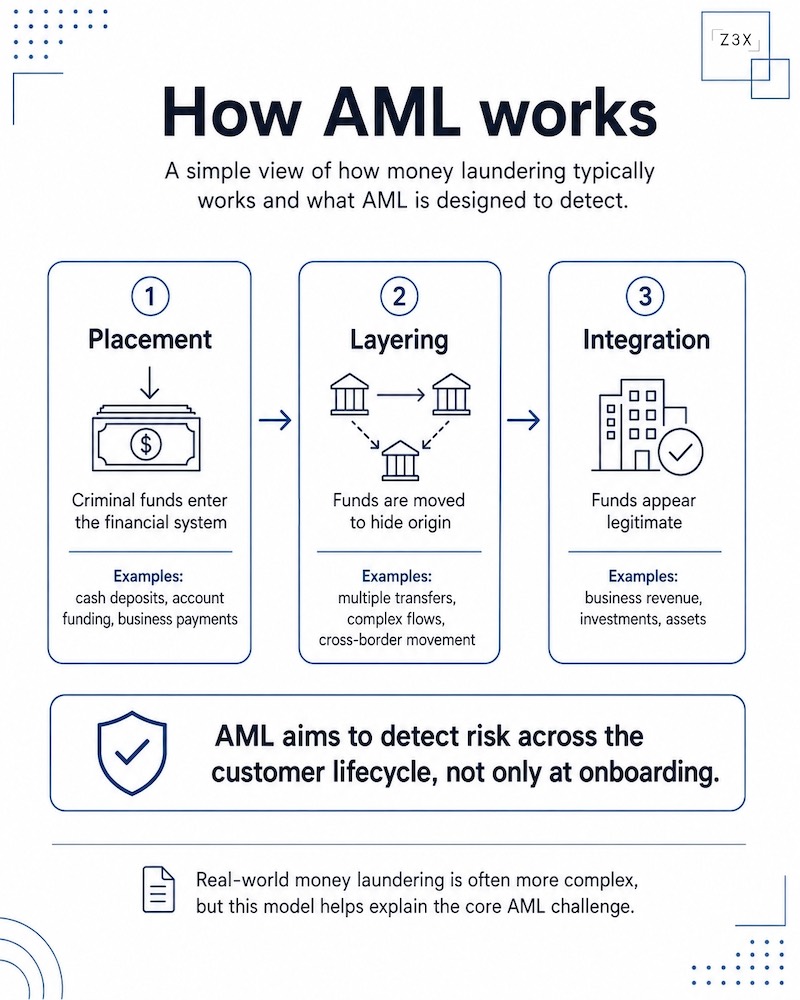
Money laundering is the process of making funds generated through criminal activity appear to come from legitimate sources.
A commonly used model describes three stages: placement, layering and integration. This model is useful for understanding the concept, but real money laundering does not always follow these stages in a clear sequence.
Placement
Placement is the stage where criminal proceeds enter the financial system or another economic activity.
Historically, this was often associated with cash. In modern financial services, however, criminal funds can enter the system through many different channels, including payment accounts, businesses, digital platforms and other financial products.
For an AML team, the important question is not only where money comes from, but whether the source and behaviour are consistent with what is known about the customer.
Layering
Layering refers to activity intended to make the origin or ownership of funds harder to understand.
This may involve moving funds between accounts, entities, jurisdictions or different financial products. The objective is to create distance between the funds and the underlying criminal activity.
From an AML perspective, unusual complexity can therefore be relevant. A transaction structure that makes little commercial sense, repeated transfers between related accounts or activity inconsistent with the customer profile may require further review.
However, complexity alone does not mean that money laundering is taking place. Many legitimate businesses have complex payment flows, especially when they operate internationally.
This is why context matters.
Integration
Integration is the point where funds appear to have a legitimate origin and can be used more openly within the economy.
The money may appear as business revenue, investment proceeds, assets or other apparently legitimate wealth.
At this stage, identifying the original criminal source can be difficult because the funds may already have passed through several transactions, accounts or entities.
This is one reason AML cannot rely only on monitoring individual transactions. Companies also need to understand customers, beneficial ownership, expected activity and changes in behaviour over time.
Modern money laundering can look very different from the traditional cash-based examples often used to explain AML.
Digital financial services allow money to move quickly between accounts, platforms and countries. Criminal networks may also use multiple individuals, companies or accounts rather than one obvious customer relationship.
This creates challenges for FinTech and payment businesses because legitimate digital activity can also be fast, international and complex.
A high transaction volume is not suspicious by itself. A cross-border payment is not suspicious by itself either. The relevant question is whether the activity makes sense in the context of the customer, product and expected behaviour.
This is where effective anti-money laundering controls become more than simple rule checking.
The company needs enough information to identify patterns, understand exceptions and recognise activity that is inconsistent with the expected use of the product.
In practice, AML therefore works best when customer information, transaction data and product context are analysed together rather than as separate compliance processes.
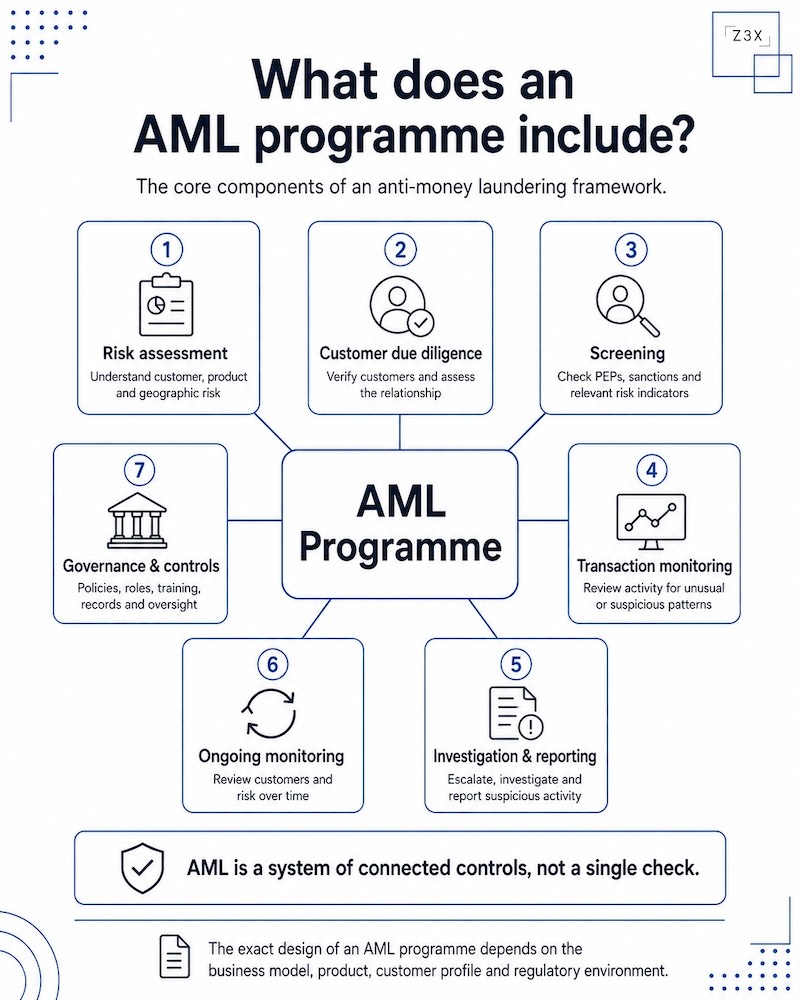
An effective AML programme is not built around one control. It is a combination of processes that work together across onboarding, customer management, transaction monitoring and internal governance.
The exact structure depends on the type of business, the markets in which it operates and the financial crime risks connected with its products.
A payment company, lender and investment platform may all need AML controls, but the design of those controls should be different.
The starting point is understanding where the main risks are.
A company should assess factors such as customer type, geography, product, transaction behaviour, delivery channel and ownership structure.
The purpose is to identify which areas require stronger controls and where standard processes may be sufficient.
A good risk assessment should reflect the actual business model. It should not be a generic document copied from another company.
Customer due diligence, or CDD, is the process of understanding who the customer is and whether the relationship creates an acceptable level of risk.
This usually includes identity verification, customer information and, for companies, understanding ownership and control.
For higher-risk relationships, additional checks may be required.
CDD is one of the most visible elements of AML because it often happens during onboarding. But it is only one part of the overall framework.
AML programmes often include screening against relevant databases and lists.
This can include politically exposed persons, sanctions lists and other risk indicators depending on the jurisdiction and the company's internal policy.
Screening usually happens during onboarding, but it may also continue throughout the customer relationship.
A customer's status can change, and external lists are updated regularly.
This is why screening should be treated as an ongoing control rather than a one-time check.
Transaction monitoring looks at how customers use the product after onboarding.
The purpose is to identify activity that may be inconsistent with the customer's expected behaviour or that matches known risk patterns.
Examples can include unusual transaction velocity, sudden changes in activity, unexpected counterparties or payment flows that do not fit the customer's profile.
An alert does not mean that money laundering has occurred.
It means the activity requires further analysis.
This distinction is important because poorly designed monitoring can create large numbers of alerts without improving risk detection.
When a transaction or behaviour requires further review, the case may be investigated by the compliance or financial crime team.
The investigation can include customer information, transaction history, previous alerts and other relevant data.
If the activity is considered suspicious, the company may have an obligation to report it to the relevant authority.
The reporting process depends on the jurisdiction.
The important point from an operating perspective is that transaction monitoring, investigation and reporting need to form one connected process.
Generating alerts without sufficient investigation capacity does not create an effective AML programme.
AML does not finish when a customer passes onboarding.
Customer circumstances can change. Ownership structures can change. Transaction behaviour can also evolve over time.
Companies therefore need mechanisms for ongoing monitoring and periodic or event-driven reviews.
For example, a significant change in transaction activity may trigger a reassessment of the customer relationship.
This is particularly important in digital products where customer activity can change quickly.
An AML framework also needs clear ownership.
Companies should know who is responsible for designing controls, reviewing high-risk cases, making escalation decisions and reporting to management or regulators.
Policies should describe how the framework works, but policies alone are not enough.
The actual product, systems and operational processes need to follow them.
Management information, internal testing and audit can help identify whether controls are operating as intended.
AML is not only the responsibility of the compliance team.
Customer support, sales, operations, product and engineering teams can all encounter information relevant to financial crime risk.
Training should therefore reflect what different teams actually do.
A generic annual compliance presentation is rarely enough for employees who make decisions that directly affect customer onboarding, payments or account restrictions.
For digital financial businesses, product and engineering teams are particularly important because many AML controls are implemented directly in software.
Companies also need to maintain appropriate records of customer checks, decisions, investigations and relevant transactions.
These records help demonstrate how the company reached a decision and whether required procedures were followed.
Good record keeping is also important operationally.
When a case is reviewed months later, the company needs to understand what information was available and why a particular decision was made.
An AML programme therefore combines regulation, technology and operations.
Its quality depends not only on whether individual controls exist, but on whether they work together as one system.
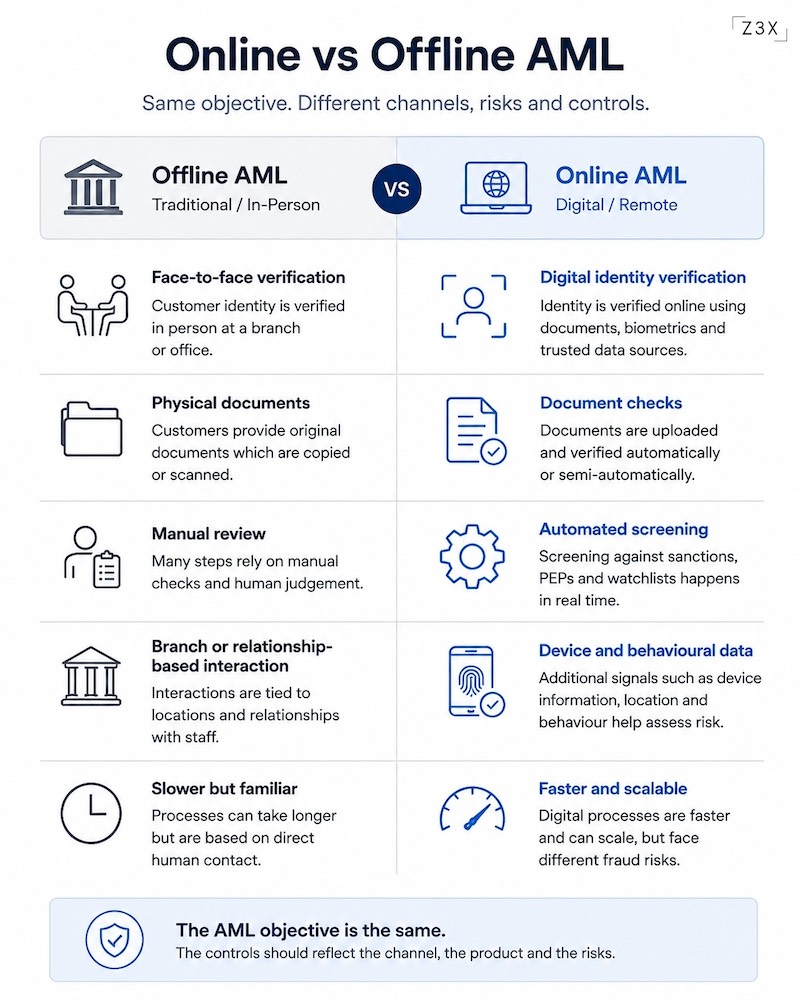
The objective of AML is the same whether a customer opens an account in a branch or through a mobile application.
The way the controls are implemented can be very different.
Digital financial services remove many physical steps from the customer journey. This improves speed and scalability, but it also changes the information available to the company and the risks it needs to manage.
Traditional financial services often include face-to-face interaction.
A customer may visit a branch, present an identity document and speak directly with an employee.
A business customer may provide corporate documents, explain its activity and meet a relationship manager.
This gives the financial institution some information that is naturally created through physical interaction.
The employee can compare the person with the document, ask additional questions and notice inconsistencies during the meeting.
Offline processes, however, can be highly manual.
Documents may need to be reviewed individually, information may be entered into several systems and complex cases can require multiple internal approvals.
This makes traditional AML processes expensive to operate and difficult to scale.
The quality can also depend heavily on individual employees.
Digital products need to achieve similar objectives without meeting the customer physically. Identity may be verified through digital identity verification, using methods such as document checks, electronic data sources, biometric verification and other remote controls.
Digital identity verification can make onboarding significantly faster and more scalable, but the technology still needs to provide sufficient confidence that the person is who they claim to be.
Business information can be obtained through corporate registries and external data sources. Screening and risk scoring can also happen automatically during onboarding.
Screening and risk scoring can happen automatically during onboarding.
This allows a FinTech to onboard customers much faster than a traditional branch-based process.
It can also make AML controls more consistent because the same rules can be applied automatically across large numbers of customers.
But online onboarding introduces different risks.
Fraudsters can attempt to use stolen identities, manipulated documents, synthetic identities or accounts created for other people.
Digital businesses therefore need controls designed specifically for remote interactions.
Online financial services also create data that may not exist in a traditional branch environment.
A company may be able to analyse device information, login behaviour, transaction patterns and changes in account usage.
These signals can support both AML and fraud detection.
For example, a company may notice that customer behaviour changes significantly shortly after onboarding.
The account may suddenly begin receiving or sending transactions that are very different from the activity declared during registration.
This type of behavioural information can be valuable because it provides context beyond the initial identity check.
Automation is one of the biggest differences between digital and traditional AML.
A digital platform can automatically verify customer information, perform screening, assign risk scores and apply different onboarding paths based on the result.
Lower-risk customers may pass through a largely automated process.
Higher-risk cases can be sent to manual review.
This can improve both customer experience and operating efficiency.
However, automation only works well when the underlying rules and data are good.
Automating a poor process simply makes the poor process run faster.
A common mistake is to assume that a digital product should have lighter AML because there is no physical branch.
The opposite is often true.
The business needs to compensate for the lack of face-to-face interaction by using appropriate digital controls.
The relevant question is not whether the customer was verified online or offline.
The question is whether the company has enough confidence in the customer's identity, understands the risk and can monitor the relationship appropriately.
Different channels can therefore use different controls while meeting the same risk objective.
Face-to-face interaction also has limitations.
An employee can be presented with a sophisticated forged document. Information can be entered incorrectly. Manual processes can be inconsistent.
Physical presence therefore does not remove financial crime risk.
Digital tools can sometimes verify information against multiple data sources more consistently than a manual process.
The strongest model depends on the product and the customer segment.
For some customers, fully digital onboarding makes sense. For others, additional documentation or human review may still be appropriate.
The key difference between online and offline AML is therefore not the regulatory objective.
It is the operating model.
A digital payment product with instant onboarding and high transaction velocity needs controls that can operate at the same speed.
A traditional relationship-based business may rely more heavily on manual review and ongoing interaction with the customer.
The AML framework should follow the product architecture.
If the service is real-time, automated and cross-border, the controls cannot depend on processes designed for branch banking.
KYC, KYB and CDD are some of the most common terms in AML.
They are closely related, but they do not mean exactly the same thing.
Understanding the difference is important because companies often describe their entire AML process simply as "KYC".
That can create a misleading picture of what the business actually needs to do.
KYC stands for Know Your Customer.
It generally refers to the process of identifying and verifying an individual customer.
This can include collecting information such as name, date of birth, address and identity documents.
In digital products, verification may also involve biometric or electronic identity checks.
The exact requirements depend on the jurisdiction, product and level of risk.
KYC is an important part of AML because a company needs to know who is using its services.
But verifying identity does not explain how the customer intends to use the product or whether their behaviour later becomes unusual.
This is why KYC should not be treated as the full AML process.
KYB stands for Know Your Business.
It applies when the customer is a company or another legal entity rather than an individual.
The process can include verifying the company's registration, legal status and business activity.
A financial institution may also need to identify directors, authorised representatives and beneficial owners.
Beneficial ownership is particularly important.
The company entering into the relationship may be a legal entity, but the AML framework also needs to understand which individuals ultimately own or control it.
KYB can therefore be significantly more complex than individual KYC.
Corporate structures may involve several entities, different jurisdictions and multiple ownership layers.
This is one reason B2B FinTech onboarding often requires a different product and operational model from consumer onboarding.
CDD stands for Customer Due Diligence.
It is broader than simply verifying identity.
CDD involves understanding enough about the customer to assess the risk of the relationship.
This can include identity, ownership, purpose of the relationship, expected activity and other information relevant to the company's risk assessment.
For a business customer, this may mean understanding what the company does, where it operates and how it expects to use the financial product.
For an individual, it may include information about the expected nature of the account relationship.
CDD therefore connects identity verification with the wider AML framework.
Enhanced Due Diligence, or EDD, applies when a customer or relationship creates higher financial crime risk.
The company may need more information, stronger verification or additional approvals before establishing or continuing the relationship.
This can include deeper analysis of ownership, source of funds or the purpose of certain transactions.
EDD should not mean simply collecting more documents.
The additional checks should respond to the specific reason why the relationship is considered higher risk.
For example, a complex corporate ownership structure may require a different review from a customer associated with a higher-risk geography.
The onboarding process should collect the information necessary to manage risk, but unnecessary checks create friction.
This is especially important in digital products.
Every additional field, document request or manual review can reduce conversion and increase operating cost.
The solution is not to minimise AML requirements.
It is to design them intelligently.
Lower-risk customers may be able to complete a largely automated process, while higher-risk cases can follow a more detailed path.
This allows the customer journey to reflect actual risk rather than applying the same process to everyone.
A customer can pass KYC or KYB and still create risk later.
The business may change. Ownership may change. Transaction behaviour may become inconsistent with what was originally declared.
This is why customer due diligence continues after onboarding.
Screening, transaction monitoring and ongoing review all add information that may change the company's understanding of the customer.
The strongest AML programmes therefore treat KYC and KYB as the beginning of the relationship, not the end of the compliance process.
For product teams, this distinction is important.
The goal is not simply to get the customer through verification.
The goal is to build a process that allows the company to understand and manage the relationship throughout its lifecycle.
Customer verification tells a company who the customer is at the beginning of the relationship.
Transaction monitoring looks at what happens afterwards.
The objective is to identify activity that may be inconsistent with the customer's profile, expected behaviour or the normal use of the product.
This is one of the reasons AML cannot stop at onboarding.
Transaction monitoring is the process of analysing customer activity to identify patterns or transactions that may require further review.
Depending on the product, this can include payments, transfers, deposits, withdrawals, account funding and other financial activity.
Monitoring can happen in real time, near real time or after transactions have already been processed.
The right approach depends on the type of financial service and the risks involved.
There is no single type of transaction that automatically means money laundering is taking place.
Monitoring systems instead look for signals that may be unusual in a particular context.
Examples can include:
sudden changes in transaction volume;
unusually high transaction velocity;
activity inconsistent with the customer's declared business;
unexpected counterparties;
unusual cross-border payment patterns;
rapid movement of funds through an account;
transactions that repeatedly approach internal or regulatory thresholds.
The context is critical.
A large international payment may be completely normal for an import business and unusual for a customer who normally receives only small domestic payments.
Effective monitoring therefore combines transaction data with information about the customer and the product.
One of the most important distinctions in transaction monitoring is between an alert and a confirmed suspicion.
An alert means that a rule, model or other control identified activity that requires attention.
It does not mean that the customer is laundering money.
The activity needs to be reviewed in context.
An analyst may look at previous transactions, customer information, counterparties, account history and the explanation for the activity.
Many alerts will ultimately have a legitimate explanation.
This is why transaction monitoring quality should not be measured simply by the number of alerts generated.
A monitoring system that generates huge numbers of low-quality alerts can become less effective rather than more effective.
Compliance teams may spend significant time reviewing normal customer activity while genuinely important cases become harder to identify.
This is commonly associated with false positives.
Reducing false positives does not mean weakening controls.
It means making monitoring more relevant to the actual risks of the product and customer base.
For example, a generic transaction rule may perform poorly if it is applied in exactly the same way to retail customers, marketplaces and international businesses.
When an alert cannot be reasonably explained, it may be escalated for deeper investigation.
The company may review additional customer information, transaction history, relationships between accounts or other relevant data.
In some cases, the business may request additional information from the customer.
In others, internal procedures may limit what can be communicated.
The process should have clear escalation paths and documented decision-making.
This is particularly important when large volumes of alerts are handled by several teams.
If a company determines that activity gives rise to suspicion, it may have a legal obligation to report the matter to the relevant Financial Intelligence Unit or other authority.
The name and format of the report differ between jurisdictions.
For example, the term Suspicious Activity Report, or SAR, is commonly used in the UK and several other markets.
The company does not need to prove that money laundering occurred before submitting a report.
Its role is to identify and report relevant suspicion according to the applicable legal framework.
The authorities can then use information from multiple institutions and other sources as part of wider financial intelligence or investigations.
Transaction monitoring works best when it is designed around how a product is actually used.
A money remittance business may focus heavily on international transfers and sender-recipient relationships.
A marketplace may need to understand flows between buyers, sellers and platform accounts.
A payment institution may analyse funding, outgoing payments and rapid movement of money between different accounts.
A lender may have much less transaction activity but still need controls around loan disbursement and repayment behaviour.
Using exactly the same monitoring rules across these products would make little sense.
The financial flows are different, so the relevant risks are different as well.
Monitoring also allows businesses to identify changes that would not have been visible during onboarding.
A customer may start with activity that fits their declared profile and later begin using the product in a completely different way.
That change may be legitimate.
A business can grow, enter new markets or change its commercial model.
But significant changes can also justify an updated customer review or risk assessment.
This connection between transaction monitoring and ongoing customer due diligence is an important part of a mature AML framework.
Modern monitoring is heavily technology-driven, especially in FinTech and payments.
But software alone does not solve the problem.
Rules need to be designed and reviewed. Alerts need to be investigated. Escalations need owners. Decisions need to be documented.
The company also needs to understand whether its monitoring continues to work as transaction volumes, products and customer segments change.
A system designed for a small FinTech may become operationally unsustainable once the business scales.
Transaction monitoring should therefore be treated as a combination of data, technology, risk methodology and operational capacity.
For FinTech companies, AML is closely connected with product design.
A compliance framework may define what needs to be controlled, but the controls usually need to be implemented inside onboarding, payment flows, account functionality and internal systems.
This makes AML different from a compliance process that can operate separately from the product.
Many important AML decisions become product decisions.
There is no single AML model for FinTech.
A payment institution, lender, remittance provider and embedded finance platform can have completely different customer relationships and money flows.
A remittance provider may deal with frequent cross-border transfers.
A payment account may allow customers to receive, hold and send money to many counterparties.
A lender may transfer funds to a customer and then receive scheduled repayments.
A marketplace may process payments involving buyers, sellers and sometimes several additional parties.
The AML framework should follow these actual flows.
Simply copying controls from another regulated company can leave important risks uncovered while creating unnecessary controls elsewhere.
Product teams often think about AML during onboarding because KYC is the most visible customer-facing process.
In reality, AML decisions can affect the entire product.
They may influence:
who can open an account;
what information needs to be collected;
transaction limits;
countries that can be supported;
payment methods;
permitted counterparties;
manual review requirements;
account restrictions;
ongoing monitoring.
These decisions should ideally be made while the product is being designed.
Adding AML controls after the product architecture is already fixed can create unnecessary engineering work and poor customer journeys.
Digital products compete heavily on onboarding speed.
Removing friction can improve conversion, but removing the wrong controls can increase regulatory and financial crime risk.
The objective should not be to make KYC as short as possible.
It should be to collect the information and evidence necessary for the level of risk without creating unnecessary steps.
This can lead to different onboarding paths.
A straightforward lower-risk customer may complete onboarding automatically.
A more complex company or higher-risk relationship may require additional information and manual review.
This approach can improve both conversion and operational efficiency.
In payment products, AML needs to reflect how funds enter, move through and leave the system. This means understanding more than individual transactions, including the relationship between senders and recipients, account funding, transaction frequency and changes in behaviour.
It is also important to separate AML from other payment risks. Fraud, disputes and chargebacks may interact with the same payment flows and customer data, but they require different controls and operating processes. If you want to understand the dispute side of card payments in more detail, see our guide: What is a chargeback?
Product features can also change AML risk. Instant payments, international transfers, high transaction limits or rapid account funding can create different monitoring requirements from a more restricted product.
Instant payments, international transfers, high transaction limits or rapid account funding can create different monitoring requirements from a more restricted product.
The faster money can move, the faster some controls may also need to operate.
A manual process that worked for next-day payments may not work for a real-time payment product.
Marketplaces and platforms can create particularly complex AML questions.
There may be a buyer, seller, platform operator, payment provider and other parties involved in the same commercial flow.
The platform needs to understand which entity has the regulated relationship with each participant and who is responsible for particular controls.
The payment architecture matters as much as the customer interface.
A marketplace that never takes control of customer funds can have a different regulatory and AML model from one that collects, holds and distributes money.
This is why AML design should begin with a clear map of the money flow.
Embedded finance can make financial services appear as part of a non-financial product.
The customer may interact primarily with a SaaS platform, marketplace or other digital brand while regulated services are provided by another financial institution.
This creates an important question:
Who is responsible for what?
A regulated partner may hold the licence and carry formal AML responsibilities, but the non-regulated platform may control important parts of the customer journey and collect relevant customer information.
The operating model therefore needs clear responsibilities, data flows and escalation processes.
A contractual statement that one party "handles AML" is rarely sufficient if the underlying product architecture does not support that arrangement.
As FinTech companies scale, AML can become a significant source of operational complexity.
If every unusual customer requires manual review, the compliance operations team may grow almost as quickly as the customer base.
The same problem appears in transaction monitoring.
High false-positive rates can create thousands of cases that need human review without generating equivalent risk value.
This is why automation, segmentation and good data architecture are important.
Scaling the business without scaling manual AML operations at the same rate is a major product and operational objective.
Poor AML implementation often comes from treating compliance and product as separate functions.
Compliance defines requirements.
Product receives them later and tries to fit them into an existing customer journey.
This can create friction, duplicated checks and controls that are difficult to operate.
A better approach is collaborative.
Compliance explains the risk and regulatory objective.
Product and engineering help determine how that objective can be implemented effectively in software.
Operations then needs to confirm that exceptions and escalations can actually be handled.
The result should be one operating model rather than several disconnected processes.
Strong AML controls are sometimes described only as a regulatory cost.
For a growing FinTech, they are also part of the infrastructure required to scale safely.
A company entering a new country needs to understand new customer and geographic risks.
A business launching a new payment feature may create transaction patterns that its existing monitoring does not cover.
A FinTech moving from consumers into business customers may need completely different KYB and beneficial ownership processes.
AML therefore needs to evolve together with the commercial strategy.
The strongest framework is not necessarily the one with the most controls.
It is the one that manages the relevant risks while allowing legitimate customers to use the product efficiently.
The European Union is undergoing one of the most important changes to its AML framework in years.
Historically, much of EU anti-money laundering regulation was based on directives that Member States implemented through national legislation.
This created a common European foundation, but differences remained between countries in interpretation, supervision and implementation.
The new EU AML package is designed to create a more harmonised system.
The package adopted in 2024 includes a directly applicable Anti-Money Laundering Regulation, known as the AMLR, a new Anti-Money Laundering Directive, and the regulation establishing the new European Anti-Money Laundering Authority, AMLA.
This is an important structural change.
A regulation applies directly across Member States, reducing the scope for different national implementations of core private-sector AML requirements.
The objective is not to remove every national difference.
National authorities, Financial Intelligence Units and local legal processes will continue to have important roles.
But the direction is towards a more consistent European AML framework.
The new AMLR, Regulation (EU) 2024/1624, brings many private-sector AML/CFT requirements into one directly applicable EU regulation.
The regulation is expected to become broadly applicable from 2027, giving businesses and authorities time to prepare for the new framework. The Council confirmed when adopting the package that the AML Regulation would apply three years after entry into force.
For businesses operating across several EU markets, this harmonisation is important.
A more consistent rulebook can make cross-border compliance architecture easier to design.
However, harmonisation should not be confused with identical supervision in every practical situation.
Local customer behaviour, financial crime risks and supervisory relationships will still matter.
The new AML Directive, Directive (EU) 2024/1640, focuses primarily on mechanisms that Member States need to establish at national level.
This includes areas such as supervision, Financial Intelligence Units and national AML systems.
As of August 2026, the European Commission reported full transposition measures from 23 Member States, while several countries still had incomplete or uncommunicated measures.
This illustrates why companies should not assume that the transition to the new framework happens everywhere at exactly the same speed.
A FinTech operating in several EU countries still needs to understand the applicable national environment during the transition.
One of the biggest institutional changes is the creation of AMLA, the Authority for Anti-Money Laundering and Countering the Financing of Terrorism.
AMLA started operations in 2025 and is based in Frankfurt.
On 1 January 2026, AML/CFT responsibilities previously held at EU level by the European Banking Authority were transferred to AMLA. Existing EBA AML/CFT guidelines and standards remain applicable until AMLA replaces them.
AMLA is therefore becoming the central EU institution for developing the common AML/CFT rulebook, supporting supervisory convergence and coordinating cooperation between Financial Intelligence Units.
This represents a significant change from the previous model, where AML supervision was more decentralised.
AMLA will not immediately supervise every regulated financial institution in Europe.
The authority is preparing to directly supervise a group of the highest-risk and most complex cross-border financial institutions.
AMLA states that 40 obliged entities are expected to be selected during 2027, with direct supervision beginning in 2028.
Most companies will therefore continue to be supervised primarily by national authorities.
However, AMLA's impact will be much broader than those directly supervised entities.
Common standards, methodologies and supervisory expectations can influence how national regulators approach the entire market.
One of the objectives of AMLA is to reduce major differences in how AML requirements are supervised across the EU.
In July 2026, AMLA announced common standards intended to create a more harmonised approach to enforcing breaches of AML/CFT rules across Member States.
For cross-border FinTech companies, this direction is important.
Historically, the same group could operate under a common European regulatory framework while still facing significantly different supervisory practices between countries.
Greater convergence should make expectations more predictable over time.
It will not eliminate the need for local expertise, but it can reduce some of the fragmentation.
EU AML regulation also sits within a wider global framework.
The Financial Action Task Force, or FATF, develops international standards for combating money laundering, terrorist financing and related threats.
Its recommendations influence AML frameworks far beyond the EU.
This matters for international FinTech companies because many core concepts are similar across jurisdictions even when the detailed rules differ.
Risk-based customer due diligence, beneficial ownership, suspicious activity reporting and ongoing monitoring are not uniquely European concepts.
The practical implementation, however, still depends on local law and supervision.
For a company operating in Europe, the transition should not be treated as a simple legal update.
Changes to AML rules can affect product requirements, customer data, onboarding, monitoring systems and internal processes.
A company expanding across several Member States should also decide which controls can be standardised at group level and which need local adaptation.
This becomes particularly important when using shared KYC, screening or transaction monitoring infrastructure.
The technology may be centralised while regulatory relationships remain local.
Even with a common European rulebook, AML risk still depends on the business model.
A cross-border remittance provider and a domestic lender should not have identical controls simply because both operate under EU regulation.
The products create different money flows, customer behaviour and exposure to financial crime.
This is why regulatory harmonisation does not mean standardising every AML process.
Companies still need to understand their own risk.
For FinTech businesses, the best approach is to use the European framework as the regulatory foundation and then design controls around the actual product, customer segments and markets in which the company operates.
The UK has its own AML framework and should be treated separately from the European Union.
The main legal framework remains the Money Laundering, Terrorist Financing and Transfer of Funds (Information on the Payer) Regulations 2017, usually referred to as the Money Laundering Regulations or MLRs. The framework is supported by other legislation, including Part 7 of the Proceeds of Crime Act 2002, which contains the principal money laundering offences and the suspicious activity reporting regime.
The MLRs have been amended several times since they were introduced. The latest significant amendments came into force on 30 June 2026 and changed areas including customer due diligence, enhanced due diligence, high-risk jurisdictions and requirements affecting cryptoasset businesses.
For companies operating in the UK, AML therefore needs to be based on the current version of the framework rather than on an older interpretation of the original 2017 rules.
The Financial Conduct Authority supervises AML compliance for a large part of the UK financial sector.
For firms within its scope, AML is not treated as a separate administrative requirement. The FCA expects appropriate systems and controls for identifying and managing financial crime risk.
Its Financial Crime Guide provides practical guidance on areas such as governance, customer due diligence, transaction monitoring and suspicious activity. The FCA also treats Joint Money Laundering Steering Group guidance as an important resource for financial services firms.
This matters because compliance is assessed based on how controls work in practice, not only on whether policies exist.
In a 2026 review of customer due diligence controls, the FCA examined areas including CDD, EDD, policies, compliance monitoring and audit. The review again showed the importance of connecting formal AML requirements with actual processes and evidence.
The Joint Money Laundering Steering Group, or JMLSG, produces detailed AML and counter-terrorist financing guidance for the UK financial services sector.
Its guidance translates legal requirements into more practical expectations for different types of financial businesses.
This is particularly useful because AML implementation can look very different across banking, payments, lending, investment services and crypto.
The FCA explicitly refers firms to JMLSG guidance as a key resource when considering their obligations.
For a FinTech company, this means that reading the legislation alone is rarely enough.
The business also needs to understand how the rules are expected to work within its specific sector and product model.
The UK AML framework expects companies to understand the financial crime risks created by their business rather than apply identical controls to every customer.
The FCA highlights customer, product, service, geography, transaction and delivery-channel risks when assessing a firm's business-wide risk assessment.
This should flow into customer onboarding, monitoring and escalation.
For example, a domestic consumer product with relatively limited functionality may require a different control environment from a cross-border payment product that allows customers to move significant amounts of money quickly.
The regulatory framework may be common, but the control design should reflect the product.
Geographic risk remains an important part of UK AML.
The 2026 amendments changed how the MLRs refer to high-risk third countries and aligned the relevant definition more closely with FATF public lists.
However, this does not mean that businesses should only consider countries appearing on a formal list.
HM Treasury makes clear that companies still need to consider broader geographic risk and apply enhanced due diligence where their own assessment identifies a high level of money laundering or terrorist financing risk.
For international FinTech companies, geographic risk therefore needs to be part of both customer risk assessment and market-entry strategy.
The UK uses the Suspicious Activity Report framework for reporting relevant suspicions of money laundering.
A company does not need to prove that a criminal offence took place before making a SAR.
The reporting system is intended to provide financial intelligence when a regulated business knows or suspects that relevant criminal property or money laundering activity may be involved.
In some cases, businesses may also need to consider whether dealing with suspected criminal property could create a money laundering offence under the Proceeds of Crime Act.
For example, the FCA notes that payment service providers can request a Defence Against Money Laundering from the National Crime Agency where they suspect that dealing with funds could expose them to one of the principal money laundering offences.
This is another example of why AML operations need clear escalation procedures.
The UK and EU AML systems still share many common principles.
Both are strongly influenced by FATF standards and both use concepts such as customer due diligence, beneficial ownership, enhanced due diligence and ongoing monitoring.
But their regulatory development is now separate.
The EU is moving towards its new AML Single Rulebook and AMLA-led supervisory structure. The UK continues to develop its own MLR framework and made further targeted amendments in 2026.
For companies operating in both regions, this means that a common group AML architecture can make sense, but it still needs jurisdiction-specific implementation.
The technology can often be shared.
The regulatory interpretation, reporting routes, supervisory relationships and some detailed controls cannot simply be assumed to be identical.
AML and sanctions compliance are closely connected, but they are not the same thing.
This distinction matters because companies frequently combine KYC, PEP checks, sanctions screening and AML monitoring inside the same onboarding or compliance platform.
The systems may overlap.
The legal objectives are different.
Anti-money laundering controls are designed to identify and manage the risk that a customer or transaction is connected with criminal proceeds, money laundering or related financial crime.
This requires context.
A customer is not necessarily prohibited from using a service simply because their activity creates a higher AML risk.
The company may instead need additional due diligence, closer monitoring or stronger controls.
AML therefore frequently involves assessment and judgement.
The question is often whether the customer's identity, activity and transaction behaviour make sense when considered together.
Sanctions work differently.
They can prohibit or restrict dealing with particular persons, companies, assets, countries, sectors or types of activity.
In the UK, the Office of Financial Sanctions Implementation, or OFSI, is responsible for the implementation of financial sanctions. Its guidance covers issues including designated persons, ownership and control, restrictions, licensing and reporting.
If a sanctions prohibition applies, the company may not simply decide that the customer presents an acceptable level of risk.
A legal restriction can prevent the activity altogether unless an exemption or appropriate licence applies.
That is a fundamental difference from normal AML risk scoring.
The most visible sanctions control is screening customer names against relevant sanctions lists.
But effective sanctions compliance is more complex.
Companies may also need to understand ownership and control.
A company may not itself appear on a sanctions list but can still be affected because it is owned or controlled by a designated person.
This creates additional challenges for KYB processes, particularly where corporate structures contain multiple ownership layers.
The result is that sanctions screening often needs access to the same corporate and beneficial ownership data used in AML.
Sanctions screening cannot be treated as a one-time onboarding check.
Designations are added, amended and removed.
Customer ownership can also change.
In the UK, the UK Sanctions List became the single source for UK sanctions designations on 28 January 2026, replacing the former OFSI Consolidated List.
Systems therefore need to support ongoing rescreening when relevant data or sanctions lists change.
This is similar operationally to ongoing AML screening, even though the underlying legal purpose is different.
Politically Exposed Person screening is also commonly included in the same compliance workflow.
A PEP is not the same as a sanctioned person.
PEP status is generally a risk factor that may require additional assessment or enhanced due diligence.
It does not mean that the person is accused of criminal activity or prohibited from using financial services.
This distinction is important for both compliance and customer experience.
Treating every match as a prohibited customer can lead to poor decisions and unnecessary friction.
From a technology perspective, there is a strong argument for connecting AML and sanctions controls.
Both may use identity information, beneficial ownership data, customer profiles and transaction information.
The same case management platform may also support investigations across several financial crime risks.
But the decision logic should remain clear.
An AML alert asks whether activity may be suspicious.
A sanctions match asks whether a specific legal restriction may apply.
A PEP match raises another type of risk question.
Combining all three into one generic "compliance score" can make decisions difficult to explain and control.
For FinTech companies, the better model is usually shared data and infrastructure with clearly separated decision frameworks.
Modern AML would be difficult to operate at scale without technology.
Digital financial businesses can onboard thousands of customers and process large transaction volumes without direct human interaction.
The AML framework needs to operate at similar scale.
Technology can automate many parts of this process, but automation should support risk management rather than replace it.
Digital identity verification is one of the most visible technologies supporting online AML and customer onboarding.
Systems can validate identity documents, extract information, compare customer details with external sources and perform biometric checks.
For business customers, similar tools can retrieve information from corporate registers and identify directors or beneficial owners.
This can significantly reduce manual onboarding work.
But the business still needs to decide what evidence is sufficient for the customer and risk involved.
A technically successful document check does not automatically mean that the customer relationship is low risk.
Sanctions, PEP and other screening can also be highly automated.
A customer's details can be checked during onboarding and rescreened when relevant lists change.
The difficult part is often not performing the search.
It is handling the result.
Names can be spelled differently. Transliteration can create variations. Multiple people can have the same name.
If matching thresholds are too broad, the system may generate large numbers of false positives.
If they are too narrow, relevant matches may be missed.
Technology therefore needs to be combined with appropriate matching logic and case review.
Transaction monitoring is another area where automation is essential.
Rules can identify particular transaction patterns and generate alerts automatically.
More advanced systems can also use statistical models, behavioural analysis and machine learning to identify activity that differs from normal customer behaviour.
This can be particularly valuable in high-volume payment products.
However, adding more rules or models does not automatically create better AML.
A system that produces thousands of low-value alerts may consume significant operational resources without materially improving detection.
False positives are often described as a technology problem.
They are also a product and operations problem.
Every unnecessary alert can create manual review work, delay customer activity and increase support costs.
At scale, poor monitoring design can require a large compliance operations team simply to process alerts.
The FCA continues to identify excessive reliance on manual processes as a weakness in financial crime controls. In its 2026 review of insurance financial crime systems, weaker control environments included outdated or incomplete processes and significant manual dependency.
The objective should therefore not be maximum alert generation.
It should be effective detection with manageable operational workload.
Technology can also help companies assign and update customer risk classifications.
Inputs may include customer type, geography, product usage, ownership structure and transaction activity.
This allows companies to route customers into different processes.
A lower-risk customer may complete onboarding automatically.
A higher-risk customer may require additional information or manual approval.
Risk scoring can therefore influence both AML effectiveness and customer experience.
But the methodology needs to be understandable.
If the company cannot explain why a customer received a particular risk classification, the model becomes difficult to govern.
One of the less visible parts of AML technology is case management.
Alerts from screening, transaction monitoring or customer reviews need somewhere to go.
Analysts need access to relevant information, previous decisions and escalation history.
Managers need to understand case volumes, ageing and outcomes.
Without a good case management layer, companies often end up moving information between several systems, spreadsheets and internal communication tools.
This creates operational risk.
The quality of an AML technology stack therefore depends not only on detection, but also on what happens after something has been detected.
AML systems depend heavily on data.
A transaction monitoring engine cannot make good decisions if customer profiles are incomplete.
A sanctions system cannot identify beneficial ownership risk if corporate information is outdated.
A risk model cannot understand expected behaviour if the company never collected that information.
This is why technology projects frequently expose weaknesses in the underlying data architecture.
Buying a more sophisticated AML tool does not fix missing or poorly structured data.
In many cases, improving data quality and system integration creates more value than adding another detection model.
Artificial intelligence and machine learning can be useful in areas such as transaction pattern analysis, entity resolution, alert prioritisation and document processing.
These technologies can help identify relationships or behaviours that are difficult to capture with simple static rules.
They can also help prioritise cases so that analysts spend more time on higher-risk activity.
But AI does not remove governance requirements.
A company still needs to understand what the system is doing, how decisions are used and where human review is required.
A model that cannot be adequately controlled or explained can create another risk instead of solving one.
The strongest AML automation does not attempt to eliminate humans completely.
It automates repetitive, predictable work and directs complex cases to the people who need to review them.
For example:
A straightforward customer may pass automated verification and screening.
An unusual ownership structure may trigger manual KYB review.
A normal transaction pattern may pass automatically.
A significant behavioural change may create an alert for investigation.
This allows skilled compliance teams to focus on decisions where judgement actually adds value.
AML technology should also improve the customer experience.
Good data and automation can prevent companies from asking customers repeatedly for information they already have.
It can allow lower-risk cases to move quickly while additional checks are targeted at the customers who actually require them.
This is particularly important for FinTech companies competing on digital onboarding.
Compliance and conversion do not always need to be opposing objectives.
A better-designed control can often improve both.
The right AML technology for an early-stage FinTech may not be the right architecture when the company operates in several countries and processes much larger volumes.
Vendor coverage, integration quality, monitoring capacity and case management requirements change as the business grows.
Companies should therefore think about AML architecture in the same way they think about other critical product infrastructure.
The relevant question is not only whether a tool works today.
It is whether the combination of data, technology and operations can support the next stage of the business without creating unacceptable risk or manual workload.
AML becomes significantly more difficult as a company grows. Processes that work well for a small customer base can become inefficient when transaction volumes increase, new markets are added and the product becomes more complex. The challenge is not only regulatory. It is also operational, technological and organisational.
One of the first problems is the growing number of manual reviews. Early-stage FinTech companies often rely on people to resolve onboarding exceptions, review sanctions or PEP matches and investigate transaction alerts. This may be manageable at the beginning, but it becomes expensive when customer volumes increase. Simply adding more analysts is rarely a sustainable scaling strategy.
False positives are another common issue. Screening and transaction monitoring systems can generate alerts for legitimate customers or transactions that happen to match predefined rules. Some false positives are unavoidable, but a badly calibrated system can create large amounts of unnecessary work and make genuinely important cases harder to identify.
This problem becomes especially visible when one monitoring model is applied to very different customer groups. A consumer, an international merchant and a marketplace seller can have completely different transaction patterns. If the same rules and thresholds are used for all of them, the system may either miss relevant risk or generate excessive numbers of alerts.
Growing companies also tend to add new customer segments over time. A business that started with consumers may begin serving SMEs, while a domestic payment provider may expand into international merchants or cross-border transfers. Each new segment can introduce different AML risks and may require different KYC, KYB, monitoring and escalation processes.
Geographic expansion creates another layer of complexity. Even when a company uses the same technology across several jurisdictions, local AML requirements, supervisory expectations and reporting procedures can differ. Customer behaviour can also vary between markets, which affects how monitoring rules should be designed.
This is particularly important in Europe. Companies may operate within a broadly harmonised regulatory environment while still interacting with different national supervisors and Financial Intelligence Units. A central AML technology stack can therefore make sense, but the operating model often needs local adaptations.
Technology fragmentation is another frequent scaling problem. Companies may use one provider for identity verification, another for sanctions and PEP screening, another for transaction monitoring and a separate platform for case management. If these systems are not well integrated, analysts may need to move between several tools to understand one customer.
Poor integration also creates data quality problems. Customer information may be duplicated, incomplete or inconsistent between systems. This weakens risk scoring, makes investigations slower and limits the value of automation.
Data quality itself becomes increasingly important as AML processes become more automated. A manual analyst can sometimes recognise that information is missing or inconsistent and compensate by checking additional sources. Automated systems are much more dependent on structured, reliable data. A sophisticated monitoring engine cannot make good decisions if the underlying customer and transaction data is poor.
Another challenge is unclear ownership between compliance, product, engineering and operations. Compliance may define the policy, product may design the customer journey, engineering may implement controls and operations may handle exceptions. If responsibilities are not clearly defined, important gaps can appear between what the policy says and what the product actually does.
Product development can also change the AML risk profile very quickly. Increasing transaction limits, introducing instant payouts, adding new funding methods or launching international transfers may change how the service can be used. AML should therefore be considered as part of product change management, not only as part of an annual compliance review.
Operational capacity is equally important. Every alert, manual review and escalation creates work that someone needs to handle. A technically sophisticated AML system can still fail if the organisation does not have enough people, clear service levels or well-defined escalation paths.
Scaling AML therefore does not mean eliminating human involvement. Complex customer structures, unusual source-of-funds questions and ambiguous transaction patterns will still require experienced judgement. The objective is to use automation for routine cases and reserve manual review for situations where it adds genuine value.
The broader lesson is that AML needs to evolve together with the business. A framework that was appropriate when the company had one product and one market may not be sufficient after several years of growth. AML should be treated as part of the company's operating architecture and reviewed whenever the business model materially changes.
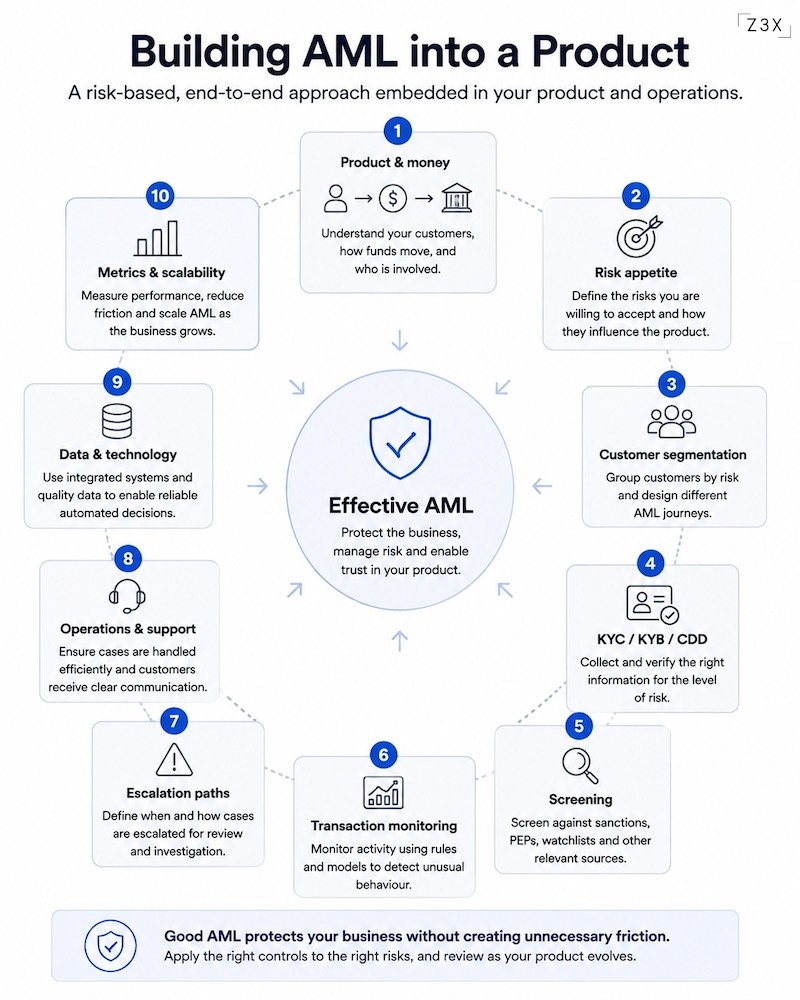
AML works best when it is designed together with the product rather than added after development is almost complete. In digital financial services, many AML requirements are implemented directly in onboarding flows, payment logic, account limits and internal systems. This means compliance requirements quickly become product and engineering requirements.
The starting point should be a clear understanding of how the product works. The company needs to know who the customers are, how funds enter the system, where they can move and which parties are involved in the transaction flow. These questions provide a much better foundation for AML design than a generic checklist.
A marketplace, lender and remittance platform may all process money, but the financial flows are very different. A marketplace may need to understand buyers, sellers and settlement structures. A remittance business may focus more heavily on senders, beneficiaries and cross-border flows. A lender may have limited transaction activity but deeper customer and source-of-funds considerations.
The next step is defining the company's risk appetite. This determines which customer types, industries, geographies and product uses the business is prepared to accept. Risk appetite should not exist only in a policy document. It needs to influence actual onboarding rules, transaction limits, monitoring and escalation decisions.
Customer segmentation can then be used to create different AML journeys. A straightforward lower-risk individual may be able to complete onboarding automatically, while a complex corporate customer may need additional ownership information or manual review. Higher-risk relationships may require Enhanced Due Diligence.
This approach can improve both compliance and customer experience. Applying the most complex process to every customer creates unnecessary friction and operational cost. The better approach is to apply additional controls where the risk justifies them.
The information collected during onboarding should also have a clear purpose. Companies sometimes collect large amounts of customer data because it may be useful later, but never integrate it into risk assessment or monitoring. This creates friction without improving the quality of the AML framework.
The opposite problem is equally common. If the company collects too little information about expected activity, later transaction monitoring becomes difficult to interpret. A system may identify unusual behaviour, but analysts have no reliable baseline against which to compare it.
Technology selection should follow the operating model rather than define it. Before choosing an AML vendor, the company should understand the customer types, jurisdictions, workflows and transaction patterns that need to be supported. A strong consumer KYC provider may not be the best solution for complex B2B KYB, and a generic monitoring platform may not understand marketplace payment flows particularly well.
Provider evaluation should therefore include more than feature lists and pricing. Companies need to understand geographic coverage, data sources, configurability, integration options, case management, scalability and how exceptions are handled. The technology should support the product rather than force the product into the vendor's standard workflow.
Clear escalation paths are another essential part of the operating model. Automated systems need rules for deciding which cases can proceed and which require human review. Operations teams then need to know who can approve higher-risk customers, who investigates alerts and when a case needs to be escalated to senior compliance staff or the MLRO.
AML controls also have a direct impact on user experience. Additional questions, document requests and manual reviews can all reduce conversion. This does not mean these controls should be removed, but they should be introduced at the right moment and explained clearly.
Exception handling is particularly important in digital products. Documents will fail verification, corporate structures will sometimes be difficult to resolve and screening systems will create false matches. The product should have a clear path for these cases instead of simply ending the journey with an error.
Customer support needs to be included in the operating model as well. Users may ask why an account is under review, why another document is required or why a payment has been delayed. Support teams need enough information to communicate appropriately without receiving access to sensitive compliance information they do not need.
Companies should also measure how AML controls perform operationally. Useful indicators can include onboarding completion, manual review rates, alert volumes, false positives, case processing times, escalation levels and backlogs. These metrics help identify whether the framework is both effective and scalable.
AML should also be reviewed whenever the product materially changes. A new payment rail, customer segment, market or funding method can create new financial crime risks. Considering AML before launch is usually much cheaper than redesigning the product after compliance issues have already appeared.
A good AML framework is therefore not the one with the highest number of controls. It is the one that applies appropriate controls to the risks created by the actual product. When designed properly, AML becomes part of scalable product infrastructure rather than a collection of manual compliance tasks.
AML is the abbreviation for Anti-Money Laundering. It describes the regulations, processes and controls used to prevent financial services from being used to disguise or move criminal proceeds. An AML programme can include customer due diligence, screening, transaction monitoring, investigations and suspicious activity reporting.
AML normally continues throughout the customer relationship. Passing identity verification during onboarding does not mean that the company's AML responsibilities have ended.
AML stands for Anti-Money Laundering. The term covers the legal and operational measures used by financial institutions and other regulated businesses to identify and manage money laundering risk.
In practice, AML is broader than a single compliance check. It combines customer information, risk assessment, monitoring, internal controls and reporting procedures.
Anti-money laundering is the process of identifying, assessing and managing the risk that a product or financial service could be used to move or disguise criminal funds. Companies do this by understanding their customers, monitoring activity and investigating behaviour that may be suspicious.
The exact obligations depend on the jurisdiction and type of business. A payment institution, lender and investment firm may all have AML obligations, but their control frameworks can look very different.
No. KYC, or Know Your Customer, is one element of the wider AML framework. It normally focuses on identifying and verifying the customer during the onboarding process.
AML continues beyond KYC. It can also include ongoing customer reviews, sanctions and PEP screening, transaction monitoring, investigations and suspicious activity reporting.
KYC primarily answers the question of who the customer is. AML addresses the broader question of how the company manages money laundering and financial crime risk throughout the relationship.
A customer may successfully complete KYC and later begin using the product in a way that is inconsistent with the original profile. That is why AML requires ongoing controls after onboarding.
CDD stands for Customer Due Diligence. It involves collecting and assessing enough information to understand the customer, the purpose of the relationship and the level of risk involved.
CDD can include identity verification, beneficial ownership information and expected account activity. Higher-risk relationships may require additional controls through Enhanced Due Diligence.
KYB stands for Know Your Business. It refers to the process of verifying a company or other legal entity and understanding who owns or controls it.
KYB can include company registration information, directors, authorised representatives and beneficial owners. It is particularly important for B2B FinTech, payment platforms and other products serving corporate customers.
FinTech companies often provide products that allow customers to receive, hold, transfer or otherwise access financial services digitally. Depending on the product and jurisdiction, these activities may create both regulatory obligations and financial crime risks.
AML therefore affects much more than compliance documentation. It can influence onboarding, transaction limits, payment flows, customer monitoring and the company's overall operating model.
Transaction monitoring is the process of analysing customer financial activity to identify behaviour that may require further review. Monitoring can use predefined rules, behavioural models and other analytical methods.
An alert does not mean that money laundering has taken place. It means that the activity should be reviewed in the context of the customer, product and expected behaviour.
A suspicious activity report is a report made to the relevant authority when a business identifies activity that meets the applicable threshold for suspicion. The terminology and reporting process differ between jurisdictions.
Companies are generally not expected to prove that money laundering has occurred before making such a report. Their role is to identify relevant suspicion and report it in accordance with local law.
Sanctions screening is closely connected with AML but addresses a different legal risk. AML focuses on detecting and managing money laundering risk, while sanctions can prohibit or restrict dealings with specific individuals, entities, countries, assets or activities.
The same customer data and technology may support both processes, but companies should keep the decision logic separate.
PEP stands for Politically Exposed Person. PEP screening identifies customers who hold or have held prominent public functions and who may therefore require additional risk assessment.
PEP status does not mean that a person is involved in criminal activity. It is a risk factor that may require stronger due diligence depending on the circumstances and applicable rules.
The formal structure depends on the jurisdiction and organisation. A company may have an MLRO, compliance department or financial crime team responsible for managing the AML framework.
However, effective AML usually involves several functions. Product, engineering, operations, customer support and senior management can all influence whether the controls work properly in practice.
Many AML activities can be automated, including identity verification, screening, customer risk scoring and parts of transaction monitoring. Automation can significantly improve scalability and reduce manual work.
However, AML cannot usually be fully automated. Complex customer relationships, unusual transactions and ambiguous cases still require investigation and human judgement. The strongest operating model normally automates predictable activity and directs higher-risk cases to experienced analysts.
So, what is AML in practical terms?
AML is not one process, one tool or one compliance check. It is a framework that combines customer due diligence, screening, transaction monitoring, investigation, reporting, governance and ongoing risk management. Its purpose is to reduce the risk that a financial product or service is used to move, hide or legitimise criminal funds.
For businesses, the important point is that anti-money laundering should reflect the actual product and operating model. A payment company, lender, marketplace and embedded finance platform may all have AML responsibilities, but the risks they face and the controls they need can be very different. Effective AML starts with understanding customers, money flows, markets and how the product is used in practice.
AML also does not end when a customer completes KYC or KYB. Customer behaviour can change, ownership structures can change and new transaction patterns can emerge over time. Ongoing monitoring and the ability to respond to those changes are therefore essential parts of a mature AML framework.
Digital financial services make this especially important. Online onboarding, instant payments and cross-border products can scale much faster than traditional financial services, which means AML controls also need to operate at scale. Automation can help, but it needs reliable data, well-designed rules and clear escalation processes behind it.
The regulatory environment is evolving as well. The European Union is moving towards a more harmonised AML framework through its Single Rulebook and AMLA, while the UK continues to develop its own regulatory and supervisory approach. Global businesses therefore need a framework that is consistent enough to scale but flexible enough to adapt to local requirements.
From a product perspective, good AML should not be treated as something added at the end of development. Customer verification, transaction limits, monitoring, escalation and operational review should be considered while the product and money flow are being designed. This usually produces better compliance outcomes and a better customer experience.
The same applies to technology. Identity verification, screening platforms, transaction monitoring and AI-based tools can improve efficiency, but they do not replace a well-designed AML framework. A sophisticated tool running on poor data or badly designed processes will still produce poor results.
For growing FinTech companies, AML is ultimately part of scalable financial infrastructure. The objective is not to create the maximum possible number of controls, but to manage relevant risks effectively while allowing legitimate customers to use the product with as little unnecessary friction as possible.
That is where strong AML creates business value. It helps companies scale safely, enter new markets, launch new financial products and increase transaction volumes without allowing compliance operations to become a permanent bottleneck.
 Karol Zielinski
Karol Zielinski
Karol Zielinski
Karol Zielinski
Karol Zielinski