
FinTech
Sept. 15, 2026, 8:55 a.m.
What is PCI Compliance?
 Karol Zielinski
Open banking has changed the way financial data and banking services can be used outside traditional bank environments. It allows customers to securely share access to selected account data or initiate payments through third-party providers, usually through regulated APIs and with the customer's explicit consent.
For businesses, open banking is much more than a technical standard. It creates new opportunities in payments, lending, financial management, onboarding, verification and embedded finance. FinTech companies can use it to build new financial products, while e-commerce and SaaS businesses can add financial functions directly into their existing customer journeys.
The concept is global, but open banking does not work in exactly the same way in every market. The European Union and the UK have played a major role in its development, with regulation helping to create the legal and technical framework for secure access to banking data and payment initiation. Other markets have followed different models, ranging from regulatory-led systems to more market-driven approaches.
So, what is open banking in practice, how does it work, and where does it create real business value? In this article, we explain the technology, the role of open banking APIs, the main use cases, security, regulation and what companies should consider when building products based on open banking.
Open banking is a model that allows customers to give authorised third-party providers access to selected banking data or payment functions. This access is usually provided through secure APIs and only after the customer gives explicit consent.
In simple terms, open banking allows a bank account to become part of a wider digital product ecosystem. A customer can use a FinTech app, an e-commerce checkout, a lending platform or a business finance tool that connects to their bank and uses specific information or payment capabilities.
The important point is that the customer remains in control. Open banking does not mean that banks make customer accounts publicly available. It means that customers can decide which provider may access which information, for what purpose and, depending on the service, for how long.
This can include access to information such as account balances, transaction history or account details. It can also allow an authorised provider to initiate a payment directly from the customer's bank account.
For businesses, this creates a layer of financial infrastructure that can be integrated into products and services. Instead of asking customers to manually upload bank statements, enter financial data or make a separate bank transfer, a company can create a more direct digital flow.
Open banking is therefore not one specific product. It is an infrastructure model that enables many different products, including account aggregation, payment initiation, financial management tools, lending, income verification, accounting integrations and embedded financial services.
It is also important to separate open banking from older methods of accessing online banking. In modern regulated open banking environments, a third-party provider does not normally need to receive or store the customer's online banking password. The customer authenticates directly with their bank, while the provider receives access to the specific data or function that has been authorised.
This distinction matters both from a security and product perspective. Open banking is designed around controlled access, clear permissions and defined roles between banks, third-party providers and customers.
From a business point of view, the real value is not the API itself. The value comes from what a company can build on top of it: a faster checkout, better credit assessment, automated reconciliation, improved onboarding or a financial product that would be difficult to deliver without direct access to banking data or payment rails.
Open banking works by creating a controlled connection between a bank, a customer and an authorised third-party provider. The customer decides when this connection should be created and what type of access should be granted.
A typical open banking flow starts inside a third-party application. This may be a FinTech app, a lending platform, an e-commerce checkout or a financial management tool. The customer chooses to connect a bank account or use a bank-based payment method.
The user is then asked to select their bank and approve the requested access. In most regulated open banking environments, authentication takes place directly with the bank. The third-party provider does not need to collect the customer's online banking credentials.
Once the customer is authenticated, the bank checks the permissions requested by the third-party provider. These permissions may relate to account information, payment initiation or both. The customer then confirms the consent.
After consent is granted, the systems communicate through an API. The bank can return authorised account information to the third-party provider or process a payment initiation request.
A simplified flow looks like this:
Customer → third-party application → customer consent and bank authentication → bank API → data or payment action
The process may look simple from the user's perspective, but several layers operate in the background. These include authentication, authorisation, API communication, consent management, security controls and, in regulated markets, verification that the third-party provider has the right permissions to provide the service.
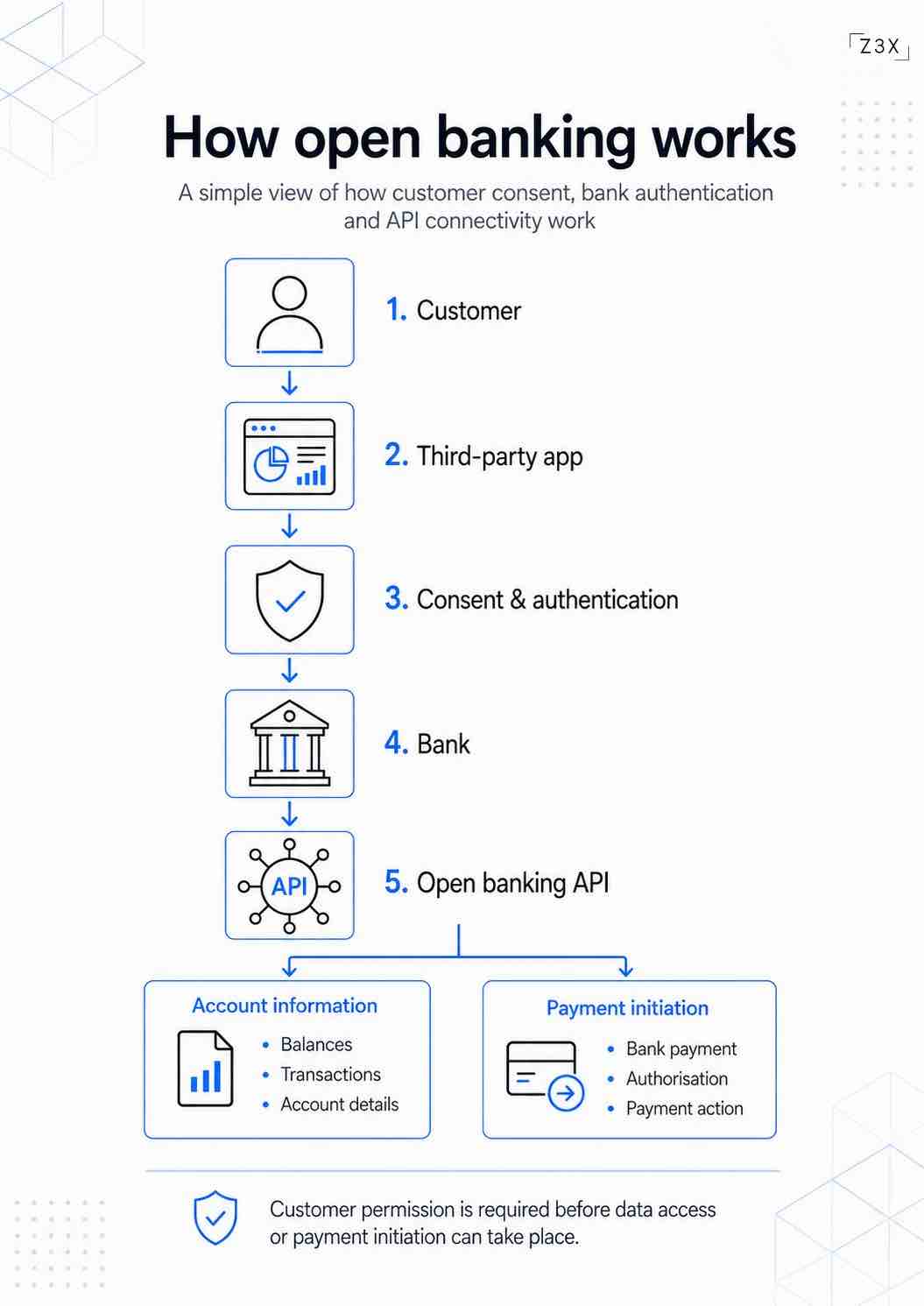
The exact flow depends on the use case. A personal finance application may request access to transaction history and balances. A lender may use account data to verify income and analyse cash flow. An e-commerce business may use open banking to let a customer pay directly from a bank account.
Payment initiation works differently from data access. Instead of retrieving information, the third-party provider sends a request to the customer's bank to initiate a transfer. The bank authenticates the customer, confirms the payment and executes it through the relevant payment infrastructure.
Open banking providers may connect directly to individual banks, but many companies use an aggregator or infrastructure provider. Such providers maintain integrations with multiple banks and expose them through one technical layer. This can significantly reduce the integration effort, especially for products operating across several countries.
However, using one API does not mean that every bank behaves in exactly the same way. API performance, authentication flows, available data, error handling and payment capabilities can differ between institutions and markets. This is one of the main practical challenges when building open banking products at scale.
From a product perspective, the API connection is only one part of the customer journey. Conversion depends on how clearly the user understands why access is needed, how easy it is to find their bank, how smooth the authentication process is and what happens when the connection fails.
This is why good open banking implementation requires more than technical integration. Product design, regulatory setup, bank coverage, user experience and operational reliability all have a direct impact on whether the service works well in practice.
Thinking about implementing open banking in your business?
z3x can help you define the right use case, select the right technology and regulatory model, and turn it into a working product.
An open banking API is the technical interface that allows banks and authorised third-party providers to exchange data or payment instructions in a structured and controlled way. It is the connection layer that makes most modern open banking services possible.
In practice, an open banking API can allow a third-party application to request specific information from a bank or send a request to initiate a payment. The exact capabilities depend on the bank, the market and the regulatory framework under which the service operates.
For example, an API may provide access to account details, balances, transaction history or other information connected with a payment account. In a payment use case, the API may allow a provider to submit a payment instruction after the customer has authenticated and approved the transaction.
The API itself does not give a third party unrestricted access to the customer's bank account. Access is limited by the permissions granted by the customer and by the scope of the service that the provider is authorised to offer.
This is an important distinction. From a product perspective, an open banking API is not a direct connection to everything a bank knows about a customer. It is a controlled interface with defined endpoints, permissions, security rules and data structures.
For companies building open banking products, the quality of the API matters significantly. Documentation, uptime, response times, error handling, authentication flows and the consistency of returned data can all affect the final customer experience.
Standardisation can reduce some of these problems, but it does not remove them completely. Even within markets where open banking is regulated, different banks may implement requirements in slightly different ways or provide different levels of API performance.
This is one reason many FinTech, SaaS and e-commerce companies use an open banking infrastructure provider or API aggregator. Instead of building and maintaining individual integrations with many banks, they integrate with one provider that manages multiple bank connections behind a common API.
This approach can reduce technical complexity and speed up market entry. It can also make expansion into additional banks or countries easier, although companies still need to consider coverage, reliability, pricing, regulatory responsibilities and the quality of individual connections.
For larger or more specialised products, direct integrations may still make sense. The decision between direct bank integrations and an aggregator depends on factors such as geographic scope, transaction volume, required functionality, internal technical resources and the level of control the company needs.
From a business point of view, the open banking API should not be treated as the product itself. It is infrastructure. The product value comes from the experience, process or financial service that the company builds on top of that infrastructure.
Most open banking services can be understood through two core types of functionality: access to account information and payment initiation. They use similar infrastructure, but they solve different business problems and lead to different types of products.
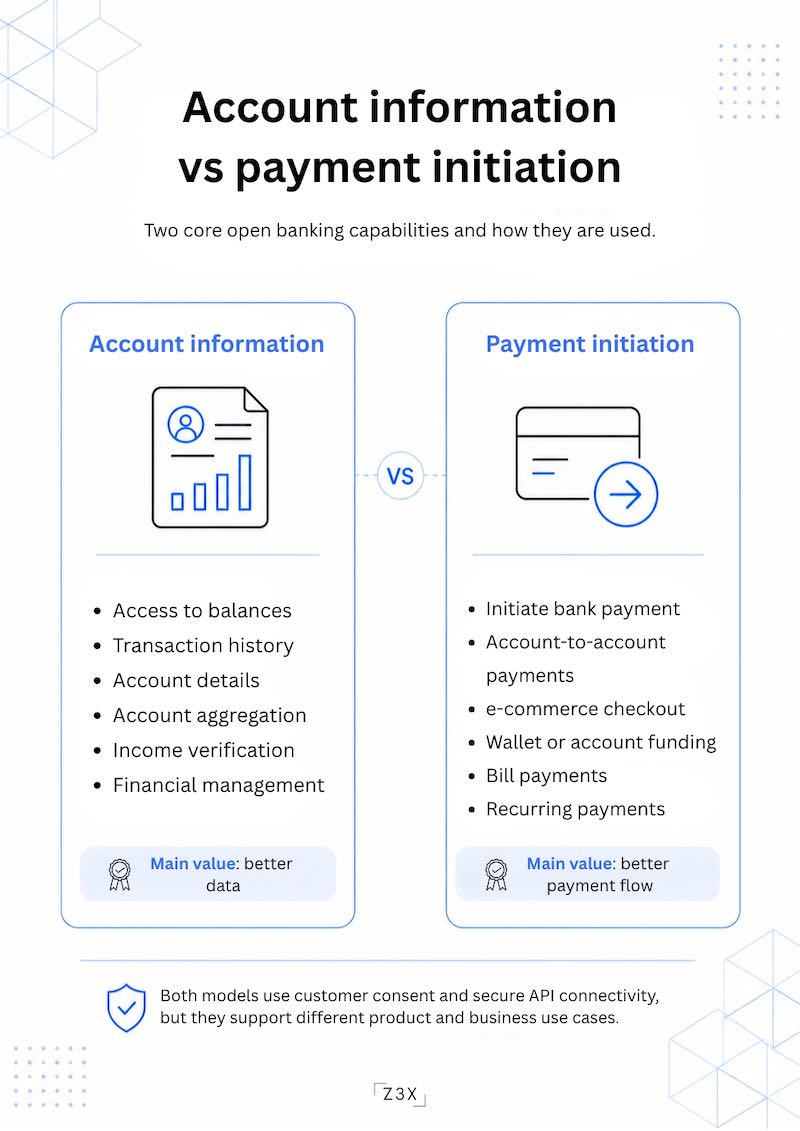
Account information services allow an authorised provider to access selected information from a customer's bank account after the customer gives consent.
Depending on the market and the available API, this may include account details, current balances, transaction history and other information related to the payment account. The provider can then use this data inside its own product or service.
A personal finance application, for example, can use account information to show accounts from several banks in one interface. A business finance platform can use it to analyse cash flow or support reconciliation. A lender can use transaction data as part of income verification or credit assessment.
The main advantage is that financial information can be collected directly from the source rather than entered manually by the customer. This can reduce friction, improve data accuracy and enable more automated decision-making.
However, access to account information is not unlimited. The provider should only receive the data required for the service and within the scope approved by the customer. Consent management is therefore a central part of the product design.
Payment initiation is different because the provider does not only retrieve information. It sends an instruction to the customer's bank to initiate a payment from the customer's account.
The customer normally starts the process inside the merchant's, FinTech's or service provider's application. The user selects their bank, authenticates with the bank and approves the payment. The bank then processes the instruction through the relevant payment infrastructure.
This creates an account-to-account payment flow without requiring the customer to manually copy bank details and create a transfer in a separate banking application.
For e-commerce and other digital businesses, this can create an alternative payment method at checkout. For FinTech companies, the same capability can be embedded into products such as wallets, investment platforms, lending services or financial management applications.
The economics and customer experience of payment initiation can differ significantly from card payments. Open banking payments may remove some layers of the traditional card value chain, but they also have their own operational requirements, user experience challenges and market-specific limitations.
This is why payment initiation should not be evaluated only as a technical payment rail. Businesses need to consider conversion, authentication, settlement, refunds, reconciliation, customer support and the payment methods that users already prefer in a given market.
Account information and payment initiation can also be combined. A product may first analyse account data and later allow the customer to make a payment within the same journey.
This combination is particularly relevant in more advanced FinTech products. It allows companies to move from simply reading financial data to building services that can both understand a customer's financial position and support an action based on that information.
Open banking is used wherever a business needs secure access to bank account data or wants to let a customer initiate a payment directly from a bank account. The technology can support both standalone financial products and financial features embedded inside non-financial services.
The strongest use cases are usually those where open banking removes a manual step, improves access to financial data or creates a more direct payment flow. The value is therefore not in the connection itself, but in the process that becomes faster, more automated or easier to use.
Account aggregation allows users to connect accounts from different banks and view them in one place. This is one of the most established open banking use cases.
For consumers, it can support personal finance management and budgeting tools. For businesses, it can provide a consolidated view of cash positions across several accounts and banks.
The same data can also be used by finance teams, accounting platforms and treasury tools. Instead of logging into several banking systems, users can access selected financial information through one interface.
Open banking can give financial management platforms access to current transaction data and account balances. This allows them to provide more useful and more up-to-date insights.
A business finance platform, for example, can categorise transactions, monitor cash flow and identify changes in spending or income. For SMEs, this can make financial management more automated without requiring complex integrations with every bank.
For product teams, however, access to data is only the starting point. The quality of categorisation, analytics and recommendations determines whether the product creates real value for the user.
Open banking can also be used to verify information that customers previously had to provide manually.
A lender may ask a customer to connect a bank account instead of uploading several months of bank statements. A FinTech platform may use account information to confirm account ownership or analyse whether regular income is being received.
This can make onboarding and verification processes faster. It can also reduce the amount of manually entered data that needs to be checked by an operations team.
The exact information available depends on the market, bank and API. Companies should therefore design verification processes around the data they can reliably access rather than assume that every bank connection will return identical information.
Lenders can use open banking data as one of the inputs in credit assessment. Transaction history can provide information about income patterns, recurring expenses, existing financial commitments and overall cash flow.
This can be particularly useful when traditional credit data provides only a limited picture of the applicant. Open banking can add a more current view of financial behaviour.
The data does not make the credit decision on its own. It still needs to be interpreted through risk models, lending policies, regulatory requirements and the lender's own underwriting process.
We discuss this use case in more detail in the section on open banking loans.
Accounting software and financial platforms can use open banking to import bank transaction data automatically.
This can reduce the need for manual uploads or periodic file exports from online banking. Transactions can be matched with invoices, expenses or accounting entries with less manual work.
The same approach can support reconciliation for businesses receiving large numbers of payments. In this case, the business value comes from operational automation rather than from the customer-facing open banking experience.
Open banking can also be used to initiate payments directly from a customer's bank account.
This is particularly relevant for e-commerce, marketplaces, financial platforms and other digital businesses. A customer can select their bank, authenticate and approve a payment without manually creating a bank transfer.
The same mechanism can also be embedded inside FinTech applications. For example, it can be used to fund an investment account, repay a loan or transfer money into another financial product.
Open banking is also an important building block for embedded finance.
A SaaS company does not necessarily need to become a full financial institution to add useful financial functions to its product. It may use open banking infrastructure to provide account connectivity, transaction analysis, payments or financial dashboards.
This is especially relevant for vertical SaaS platforms. A platform serving restaurants, retailers, freelancers or logistics companies may already understand the operational context of its customers and can add financial functionality directly into the same workflow.
In such cases, open banking works best when the financial feature is part of a broader product rather than a separate service. The user may not even think about open banking as a technology. They simply see that a previously manual financial process now happens inside the software they already use.
Building a product with open banking?
z3x can support you from strategy and provider selection through product design, integration, compliance and go-to-market.
Open banking payments allow a customer to initiate a payment directly from a bank account through a third-party application. They are commonly described as account-to-account, or A2A, payments.
The basic idea is simple. Instead of entering card details or manually creating a bank transfer, the customer selects their bank, authenticates with it and confirms the payment.
For merchants and FinTech companies, this creates another payment option that can be integrated into the checkout or product journey.
A typical open banking payment starts on the merchant's or service provider's website or application.
The customer chooses an open banking payment method and selects their bank. The customer is then taken through the bank's authentication process, where the payment details can be reviewed and approved.
The payment initiation provider sends the instruction to the bank through the relevant API. The bank then processes the payment using the payment infrastructure available in that market.
From the customer's perspective, the process should feel like part of one continuous checkout. Behind the scenes, however, the merchant, open banking provider, customer's bank and payment system all need to work together.
Open banking payments and card payments solve the same basic problem, but they use different infrastructure.
A card payment normally moves through a card-based ecosystem that includes several participants. An open banking payment is initiated from the customer's bank account and uses bank payment infrastructure instead.
This can change the economics of the transaction. In some use cases, account-to-account payments can reduce the number of intermediaries involved and create a more direct flow between the payer and the recipient.
But the comparison should not stop at transaction cost. Cards provide a mature global acceptance network, established consumer behaviour and well-developed processes for areas such as refunds, disputes and recurring payments.
Open banking payments have different strengths. They can be particularly attractive where users are comfortable with bank authentication, where transaction values are relatively high or where direct account-to-account movement creates operational advantages.
The right choice therefore depends on the product, customer segment and market. Open banking should usually be evaluated as part of a payment mix rather than as a universal replacement for cards.
In e-commerce and online payments, open banking can be added as a payment method at checkout.
A strong implementation should minimise the number of steps between choosing the payment method and completing the transaction. Bank selection, authentication and confirmation all affect conversion.
This is important because payment success is not only a technical issue. A technically successful API integration can still perform poorly if customers do not recognise the payment method, struggle to find their bank or abandon the authentication process.
Merchants should therefore analyse open banking in the same way they analyse other payment methods. This includes conversion, payment success rate, transaction cost, settlement, customer support, refunds and reconciliation.
The business case may also differ by customer segment. A payment method that performs well for high-value purchases or B2B transactions may not perform equally well for low-value consumer purchases.
B2B payments are another important use case.
Businesses frequently deal with invoice payments, account funding, supplier payments and other workflows where bank transfers are already common. Open banking can improve these processes by making the payment initiation part of the software workflow.
For example, an accounting or invoicing platform can allow a customer to initiate a payment without separately logging into online banking and manually entering payment details.
This can reduce manual errors and improve reconciliation because the payment can be linked to the invoice or transaction that created it.
In B2B products, these operational benefits can be as important as the payment cost itself.
Recurring payments are more complex.
Traditional open banking payment initiation was primarily designed around individual payments that the customer explicitly approved. This works well for one-off purchases but is less suitable for subscription models and other recurring payment scenarios.
Newer models are addressing this limitation. In the UK, for example, Variable Recurring Payments allow a customer to give a provider permission to initiate payments within agreed parameters rather than approve every payment separately.
This creates opportunities for use cases such as account sweeping, subscription payments and other repeated transactions. It also brings open banking closer to use cases traditionally served by cards or direct debit.
However, recurring open banking payments are not equally available in every market. Product teams need to understand the capabilities of the specific country, banks and providers they plan to use.
A common mistake is to evaluate open banking payments only at the checkout stage.
A production payment product must also deal with what happens after the customer clicks "pay". The merchant needs to know whether the payment was successfully initiated, whether the funds have arrived and how the transaction should be reconciled.
Refunds also need to be designed carefully. The refund process may not mirror the original payment flow in the same way it does in a card environment.
This becomes particularly important for marketplaces, platforms and businesses processing large payment volumes. Payment status, reconciliation and exception handling can create significant operational complexity if they are not designed properly.
Open banking payments make the most sense when they solve a specific commercial or operational problem.
That may be reducing payment costs, creating a better bank transfer experience, improving reconciliation or enabling payments inside a broader financial product.
They can also be attractive for higher-value transactions, where the economics of the payment method become more important.
But adding open banking simply because the technology is available is rarely a strong product strategy. The payment method needs to fit the customer journey, local payment behaviour and the economics of the business.
For FinTech, e-commerce and SaaS companies, the relevant question is therefore not whether open banking payments are better than cards or other payment methods in general. The right question is where they provide a better result for a specific customer, transaction type and market.
Open banking has become an important data source for digital lending. It allows lenders to access selected account information, with the applicant's consent, and use it as part of the credit assessment process.
This can make lending decisions more data-driven and reduce the amount of information that applicants need to provide manually. Instead of uploading bank statements or entering income and expense data into a form, the applicant can connect a bank account and allow the lender to analyse relevant financial information directly.
The term open banking loans usually refers to lending products where open banking data is used during application, underwriting, affordability assessment or servicing. Open banking does not create a separate type of loan. It changes how information can be collected and used during the lending process.
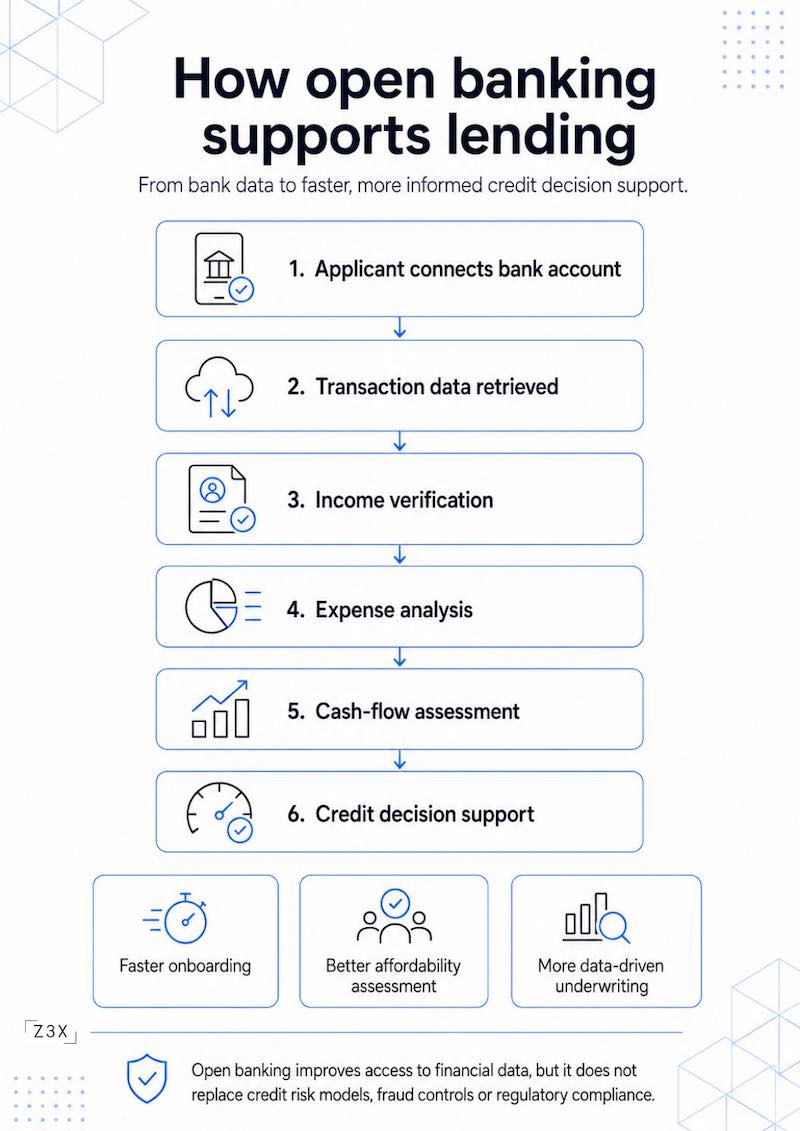
One of the clearest use cases is income verification.
Transaction data can help a lender identify recurring salary payments, business income or other regular sources of funds. This can reduce dependence on manually submitted documents and make the verification process faster.
For consumer lending, this may mean identifying salary payments and their regularity. For SME lending, the analysis can be broader and include incoming payments, revenue patterns and cash-flow changes over time.
The challenge is that transaction data needs to be interpreted correctly. A transfer received every month is not automatically salary, just as revenue entering a business account does not automatically represent profit or available cash.
This is why transaction categorisation and data analysis are critical parts of an open banking lending product.
Open banking can also provide a more detailed view of the applicant's regular expenses and financial commitments.
A lender may analyse housing costs, loan repayments, subscriptions, utility payments and other recurring spending. Combined with information about income, this can support an affordability assessment based on actual account activity.
This can be more useful than relying only on information declared by the customer. It can also allow parts of the assessment to be automated.
However, automated does not mean simple. Transaction data can be incomplete, irregular or difficult to categorise. Applicants may also use several bank accounts, which means one connected account may not provide a complete picture of their financial situation.
Product teams should therefore avoid treating an open banking connection as a perfect representation of the customer's finances.
Open banking is particularly relevant to cash-flow-based underwriting.
Traditional credit assessment often relies heavily on credit bureau information, financial statements or historical information supplied by the applicant. Open banking can add a more current view of how money actually moves through an account.
For an SME lender, this can include revenue patterns, seasonality, concentration of incoming payments, recurring expenses and changes in available liquidity.
For consumer lenders, it can provide information about income stability and spending behaviour.
This does not mean that open banking data should replace traditional risk information. In many cases, the strongest underwriting model combines several data sources rather than relying on one of them.
SME lending is one of the areas where open banking can create significant operational value.
Small businesses do not always have the same depth of financial reporting as larger companies. Their financial position can also change quickly, which makes recent transaction and cash-flow data particularly useful.
A lender may use bank account data to better understand turnover, recurring costs and liquidity. This can support faster initial assessment and reduce the amount of documentation required from the business.
Open banking can also help lenders serve segments where traditional underwriting is expensive relative to the size of the loan. More automation can improve the economics of processing smaller applications.
The commercial opportunity is not only faster credit decisions. A better data flow can also improve customer experience and reduce manual work for sales, underwriting and operations teams.
It is important not to overstate what open banking can do.
Access to transaction data does not automatically produce a good credit decision. The lender still needs a credit strategy, risk models, decision rules, fraud controls and appropriate regulatory processes.
The same transaction data can also mean different things in different contexts. A sudden decline in account balance may be a risk signal in one case and normal seasonal behaviour in another.
The lender therefore needs to understand both the data and the customer segment.
Open banking should be treated as an additional source of high-quality financial information. Its value depends on how this information is incorporated into the overall underwriting process.
From a product perspective, lenders should also consider what happens before the data reaches the risk model.
Customers need to understand why they are being asked to connect a bank account and what information will be used. If the value exchange is unclear, some applicants may abandon the process.
Bank selection, authentication and connection reliability also affect application conversion.
A lender may therefore improve underwriting quality while at the same time creating additional friction in the application journey. The right implementation needs to balance both sides.
For companies building open banking loans, the strongest use case is not simply "more data". It is a better lending process based on faster access to relevant financial information, better automation and a customer journey that still remains easy to complete.
Want to use open banking to improve payments, lending or financial workflows?
We help FinTech, e-commerce and SaaS companies design and implement solutions that create real business value.
A common question from both consumers and businesses is: is open banking safe?
In regulated open banking environments, the model is designed to provide controlled access to banking data and payment functions rather than give third parties unrestricted access to a customer's account. Access normally requires customer consent, appropriate authentication and a defined technical connection between the provider and the bank.
This makes open banking fundamentally different from simply giving another company access to online banking credentials.
However, saying that open banking is safe does not mean that every implementation carries the same level of risk. Security depends on the regulatory framework, the provider, technical implementation, authentication process and how customer data is handled after it has been retrieved.
Consent is one of the central principles of open banking.
A provider should request access for a specific purpose and to a defined scope of information or functionality. The customer decides whether to grant that access.
For example, a financial management application may request permission to access account balances and transaction history. A payment provider may request permission to initiate a specific payment.
These are different permissions. Connecting an account for one purpose should not automatically give a provider unrestricted access to other functions.
This principle is important both for security and for customer trust.
In modern API-based open banking, customers generally authenticate with their bank rather than provide their online banking credentials directly to the third-party application.
A user may be redirected to the bank's application or authentication environment, or the authentication may take place through another secure bank-controlled flow.
The third-party provider receives the result and the access that has been approved, rather than the customer's banking password.
This significantly changes the security model compared with older approaches based on sharing or collecting online banking credentials.
In the European Union, Strong Customer Authentication is an important part of the payment security framework.
It generally requires authentication based on at least two independent elements from different categories, such as something the customer knows, possesses or is.
In practice, this can include combinations such as a password or PIN, possession of a registered device and biometric authentication.
For open banking products, authentication requirements affect both security and conversion. A highly secure flow that creates unnecessary complexity can lead to customer drop-off, while a badly designed flow can create confusion or mistrust.
This is why authentication is not only a compliance topic. It is also a product design issue.
In markets where open banking is established through regulation, providers performing regulated activities may need appropriate authorisation or registration.
This creates a formal framework around who can access bank data or initiate payments and under which conditions.
For businesses integrating open banking services, provider selection should therefore include more than API coverage and price. Regulatory status, security processes, operational resilience and data handling should also form part of vendor due diligence.
A technically strong API provider can still be a poor strategic choice if its regulatory model does not fit the company's product or expansion plans.
An open banking API is designed to provide specific data or functionality through controlled technical interfaces.
Authentication between systems, access tokens, certificates, encryption and permission management can all form part of the security architecture.
The important point is that API access can be limited. A provider can be authorised to perform specific actions rather than receive general access to the entire banking environment.
Good API design also allows access to be monitored and controlled more effectively than many older methods of exchanging financial data.
However, APIs are not automatically secure simply because they are APIs. Poor implementation, incorrect permissions, insecure infrastructure or weak internal security controls can still create risk.
This is one of the most important questions in open banking security.
The bank may operate a secure API and authentication process, but a third-party provider may then store, analyse or process the retrieved information within its own infrastructure.
Companies therefore need to consider data security across the entire lifecycle, not only during the API connection.
This includes questions such as what data is stored, how long it is retained, who can access it and whether all collected information is actually necessary for the service.
For B2B buyers selecting an open banking provider, these questions should be part of technical and compliance due diligence.
Open banking can improve security in some parts of a financial journey, but it does not remove fraud.
Fraudsters can still use social engineering, impersonation and manipulated customer journeys to convince people to approve transactions or share information.
A payment may be technically authenticated correctly while the customer has been deceived into making it.
This distinction is important for businesses building payment products. Authentication confirms that an authorised user completed an action. It does not always confirm that the underlying transaction is legitimate.
Fraud prevention therefore still requires monitoring, risk controls and appropriate customer communication.
Depending on the market and service, users can usually withdraw consent or disconnect a service that has been given access to their account information.
Consent management should therefore be treated as part of the product lifecycle rather than as a one-time step during onboarding.
Users should be able to understand what they have authorised and how access can be changed or removed.
For product teams, clear consent management also reduces customer support problems and improves trust.
Users should understand which company is requesting access, what information it needs and why that information is required.
They should also authenticate through the expected bank environment and be cautious if a service unexpectedly asks them to provide their complete online banking credentials directly.
In regulated markets, users can also check whether the provider has the appropriate regulatory status for the service it offers.
For businesses, similar principles apply at a deeper level. Due diligence should cover regulation, information security, data processing, API reliability, incident management and the provider's dependencies on other infrastructure companies.
Open banking can provide a secure way to access banking data and initiate payments when it is implemented within a strong regulatory and technical framework.
Its security model is based on controlled access, customer consent, bank authentication and clearly defined permissions rather than unrestricted account access.
But security should never be treated as a checkbox. The open banking provider, the bank, the company building the product and the customer journey all form part of the final security model.
For FinTech, e-commerce and SaaS companies, this means that selecting an open banking provider only on the basis of functionality or price is not enough. Security, regulatory setup, data governance and operational resilience need to be considered at the same stage as the API integration itself.
The European Union has been one of the most important markets in the development of open banking. Its model is primarily regulation-led, with banks and other payment service providers operating within a common legal framework for access to payment accounts and payment services.
The key regulatory foundation has been the revised Payment Services Directive, commonly known as PSD2. It created a legal framework for third-party providers to offer account information and payment initiation services across the EU.
PSD2 did not create open banking as a commercial product. Instead, it established the regulatory conditions that allowed new providers to access payment accounts and compete with services traditionally delivered by banks.
Two concepts are particularly important for understanding European open banking.
Account Information Services, or AIS, allow authorised providers to access information from payment accounts with the customer's consent. This is the regulatory foundation behind many account aggregation, financial management and data-driven FinTech services.
Payment Initiation Services, or PIS, allow authorised providers to initiate payments from a customer's payment account. This created the regulatory foundation for many open banking payment products.
Providers offering these services are commonly referred to as third-party providers, or TPPs. Banks servicing the underlying payment accounts are usually described as Account Servicing Payment Service Providers, or ASPSPs.
These terms may sound regulatory, but they represent a simple product architecture. The bank holds the account, the third party provides the customer-facing service, and the regulatory framework defines how the two can interact.
Before PSD2, a FinTech company that wanted access to customer bank account information often had limited options. Access could depend on bilateral relationships with banks, customer-provided documents or technical methods that were not designed as formal banking interfaces.
PSD2 changed this by creating a regulated right of access for authorised providers. Banks had to support access to payment accounts for account information and payment initiation services under defined conditions.
This was strategically important for the FinTech market. A company no longer necessarily needed a commercial agreement with every bank before it could build a service based on access to customer payment accounts.
It also changed the role of banks. An account could become an infrastructure layer for products delivered by another company.
One of the most important practical points is that PSD2 created regulatory access, but it did not create one identical open banking API used by every bank in Europe.
Different API standards and implementation approaches developed across the market. Banks also interpreted technical and regulatory requirements differently.
As a result, a provider operating across Europe may still experience differences in API behaviour, available data, authentication flows, error handling and reliability.
This is one of the reasons open banking aggregators became an important part of the European ecosystem. They abstract much of this complexity and provide one integration layer across multiple banks and countries.
But abstraction does not remove the underlying differences. If a bank API performs poorly, adding an aggregator between the bank and the FinTech does not automatically solve the problem.
This is an important consideration when planning a multi-country product. A statement such as "we support open banking in Europe" says very little about actual coverage and customer experience.
PSD2 also introduced Strong Customer Authentication, or SCA, as an important part of the European payment security framework.
SCA affects many open banking journeys because customers need to authenticate when accessing accounts or authorising certain payment actions.
From a regulatory perspective, this strengthens payment security. From a product perspective, authentication has a direct impact on conversion.
A customer who starts an open banking payment may move between a merchant interface, an open banking provider and a banking application before the payment is completed. Every additional step creates another potential point of abandonment.
Good implementation therefore requires product teams to understand both the regulatory requirement and the actual authentication experience offered by individual banks.
The EU is now moving towards the next generation of its payment services framework.
The European Commission proposed a new Payment Services Directive, PSD3, and a directly applicable Payment Services Regulation, PSR, in 2023. The objective is broader than open banking, but improving the functioning of open banking is explicitly part of the package.
The European Parliament and Council reached a provisional political agreement on PSD3 and PSR on 27 November 2025. The European Parliament's ECON committee subsequently approved the negotiated text in May 2026. At the time of writing, the package still requires formal adoption by Parliament and Council before it can enter into force.
This distinction is important. PSD3 and PSR should not yet be described as the current legal framework replacing PSD2.
One objective of the new framework is to reduce obstacles that third-party providers still encounter when accessing payment accounts.
The negotiated legislation addresses barriers to open banking access and is intended to prevent account-servicing providers from discriminating against authorised open banking providers. It also introduces stronger tools for customers to monitor and manage permissions granted to third parties.
This is relevant because the first phase of European open banking demonstrated that regulatory access alone is not enough. The quality of access matters as well.
A technically available API has limited commercial value if authentication is unreliable, data is incomplete or a customer repeatedly fails to complete the connection.
The next regulatory phase is therefore increasingly about making open banking function better in practice rather than simply establishing the right to access an account.
For a company entering the European market, it is tempting to treat the EU as one open banking region.
From a regulatory strategy perspective, there are clear benefits to the common European framework. From a product and go-to-market perspective, however, individual markets still need to be analysed separately.
Bank coverage, customer behaviour, domestic payment infrastructure, preferred payment methods and API performance can differ substantially between countries.
The strongest providers therefore combine regulatory scalability with local market knowledge.
If a FinTech wants to launch open banking payments in several European countries, the question is not only whether the API provider technically supports those countries. The company should also understand which banks are covered, how customers authenticate, which payment rails are used, how payments are confirmed and how the method competes with existing local payment options.
This is where regulatory access becomes a product and go-to-market problem.
The UK is one of the most developed open banking markets, but its development followed a different path from the European Union.
While EU open banking was driven primarily by PSD2, the UK combined payment services regulation with a competition-led programme focused on standardisation and implementation.
This difference is important. The UK did not only require banks to provide access. It also developed a much more standardised technical framework around how that access should work.
The UK open banking framework was built around common API standards, security profiles, customer experience requirements and operational guidelines.
This created greater consistency between participating banks and third-party providers than in many European markets.
For product companies, standardisation has practical value. It reduces the number of bank-specific differences that need to be handled and makes it easier to create customer journeys that behave consistently across institutions.
It does not mean every bank connection is identical or that every integration problem disappears. But the common standards create a stronger foundation for interoperability.
This is one of the main reasons the UK is often treated as a distinct open banking market rather than simply another implementation of European payment regulation.
The first phase of UK open banking focused heavily on creating access and ensuring that the required infrastructure existed.
The market has gradually moved towards a different question: how can that infrastructure support commercially sustainable products?
This shift matters.
A regulatory API may satisfy an access requirement without creating a viable business model for every participant. Long-term open banking requires incentives for banks, FinTech companies, payment providers and infrastructure companies to invest in new services.
The UK is therefore increasingly developing a model that combines common standards with commercial schemes built on top of those standards.
The FCA expects the future framework to include a common standards layer and a competitive layer of commercial open banking schemes. The planned Future Entity is expected to become the main standards-setting body, while commercial scheme operators will be able to develop services using the common infrastructure.
The institutional structure of UK open banking is also changing.
Open Banking Limited has played a central implementation role, but the UK is working towards a new long-term governance model.
The FCA has stated that, subject to legislation, the Future Entity is expected to become the primary standards-setting body for UK open banking APIs. Its expected responsibilities include common standards, API performance monitoring, certification and directory services.
The design process continued during 2026, with the industry participating in the development of the new body.
This is more than an organisational change. Governance determines who sets standards, who monitors performance and how commercial open banking services can develop.
For companies building on UK open banking, the transition matters because the ecosystem is moving from an implementation structure created for the initial phase of open banking towards permanent infrastructure.
The Data (Use and Access) Act 2025 created new powers for Smart Data schemes in the UK, including frameworks such as open banking.
This provides a legal foundation for the next stage of open banking governance and potentially for broader data-sharing models.
The UK government is now developing the long-term regulatory framework that will use these powers. In July 2026, HM Treasury published a consultation on modernising payment services regulation that includes the future regulatory structure for open banking and the proposed role of the FCA.
The direction is important for FinTech companies. UK open banking is moving away from a framework heavily dependent on the original competition remedy towards a permanent regulatory and commercial model.
Variable Recurring Payments, or VRPs, are one of the most important areas of development in UK open banking.
A VRP allows a customer to authorise a provider to make a series of payments within agreed parameters. This is different from a standard open banking payment where the customer typically approves one payment at a time.
The original implementation focused on sweeping, where money is moved between accounts belonging to the same customer. The market is now expanding towards commercial Variable Recurring Payments, commonly referred to as cVRPs.
Commercial VRPs could support use cases such as utility payments, financial services payments and other recurring transactions. The FCA and Payment Systems Regulator have been actively supporting the development of the commercial model, including work on the pricing structure for the emerging UK Payments Initiative.
This is strategically significant because recurring payments have historically been one of the limitations of open banking payment initiation.
If open banking can support reliable commercial recurring payments, it can compete in a wider range of use cases currently served by cards and Direct Debit.
The UK also illustrates how open banking payments can evolve beyond regulatory compliance.
Providers now compete on checkout experience, bank coverage, payment conversion, reconciliation, merchant tools and commercial terms.
This changes the competitive landscape.
The underlying bank API becomes infrastructure. The differentiation moves to the product layer above it.
For merchants, the decision is therefore not simply whether to "accept open banking". They need to evaluate providers in the same way they evaluate other payment solutions.
This includes conversion, customer recognition, bank coverage, settlement, refunds, reconciliation, fraud controls, integration effort and commercial terms.
The long-term ambition is broader than access to payment accounts.
The Data (Use and Access) Act provides a broader Smart Data framework, and the FCA has indicated that the Future Entity's role could eventually expand into open finance.
Open finance would extend data sharing beyond the core open banking scope into other areas of financial services.
This could eventually include products such as savings, investments, pensions, insurance and lending. The UK government already describes open finance as the next phase of open banking, based on secure access to a wider range of financial data.
For FinTech companies, this creates a much larger potential product landscape. Instead of connecting only to payment accounts, future services could build a more complete financial view of a consumer or business.
For companies operating internationally, the most important point is that EU and UK open banking should not be treated as the same implementation.
Both markets support regulated account information and payment initiation. Both rely heavily on APIs and customer consent.
But their standards, regulatory structures, market development and commercial models are different.
A product that works well in the UK cannot simply be copied into several EU countries with the assumption that customer experience, API performance and payment behaviour will remain the same.
The reverse is also true.
A successful open banking strategy therefore starts with the use case and the target market, not with the technology provider. The API may be global, but the product still needs to work locally.
Open banking is now a global concept, but there is no single global open banking model.
Different countries have created different rules for how financial data should be shared, which institutions need to participate and which types of services can be provided. Some markets started with regulation, while others developed through commercial agreements and industry standards.
For companies building international FinTech products, this distinction matters. An open banking API that works in one country cannot automatically be expected to provide the same data, customer journey or functionality in another.
In practice, global open banking models can broadly be divided into regulatory-led, market-led and hybrid approaches.
In regulatory-led markets, legislation or regulatory requirements establish rights and obligations around access to financial data.
The European Union is a clear example. PSD2 created a framework under which authorised third-party providers can access payment account information and initiate payments with customer consent.
The UK also has a strong regulatory foundation, although its implementation has placed greater emphasis on common technical standards and governance.
Regulatory-led models can accelerate market development because banks cannot simply decide whether they want to participate. The rules create a framework that new market participants can build on.
However, regulation does not guarantee a good product environment.
A bank can technically provide access while still offering an API or authentication journey that performs poorly. This is why API quality, standardisation and implementation rules become important after the initial regulatory framework is established.
Other markets have historically relied more heavily on commercial relationships between banks, FinTech companies, data aggregators and technology providers.
The United States is an important example. Financial data sharing developed for years through private-sector integrations and industry arrangements rather than through a PSD2-style open banking mandate.
The regulatory direction has been evolving. Section 1033 of the Consumer Financial Protection Act establishes consumer rights relating to access to financial data, and the Consumer Financial Protection Bureau issued its Personal Financial Data Rights rule in 2024. The CFPB subsequently started a process to reconsider parts of that rule, which means the US framework continues to evolve.
This illustrates an important point about global open banking.
A market may already have extensive financial data connectivity without having the same regulatory architecture used in Europe. Commercial APIs, data networks and industry standards can develop before regulation creates a formal open banking framework.
For a product company, the result may look similar at the user interface level. A customer connects a bank account and allows a third party to access financial information.
Behind that interface, however, the legal rights, technical standards, commercial relationships and responsibilities between participants can be very different.
Australia took another approach.
Open banking was introduced as part of the broader Consumer Data Right, or CDR. The CDR allows consumers to consent to data being shared with accredited third parties and was designed as a framework that can extend beyond banking.
This is strategically different from treating open banking as a payment-sector initiative only.
Banking becomes one part of a wider data portability model. The same basic idea can potentially be applied to additional industries and additional types of consumer data.
For FinTech companies, this broader architecture can create opportunities beyond traditional account aggregation or payment initiation.
It also means that companies entering Australia need to understand CDR-specific accreditation, consent and data-sharing requirements rather than assume that European open banking models apply.
Brazil provides another useful example because its framework has explicitly developed towards open finance, not only open banking.
The Central Bank of Brazil describes Open Finance as a system intended to improve competition and efficiency in credit and payments by allowing customers to share financial information between authorised institutions.
The scope extends beyond basic payment account information into a wider range of financial products and services. This includes areas such as investments, insurance and pensions.
Brazil therefore shows how a market can move relatively quickly from bank account connectivity towards a broader financial data ecosystem.
For product companies, this creates a larger opportunity. The same customer permission framework can potentially support products that combine data from several parts of a customer's financial life.
The phrase "open banking" is often used as if it describes one specific technology.
In reality, it can describe several related models.
In one market, open banking may primarily mean regulated access to payment accounts. In another, it may include a wider range of financial products. In another, it may still depend substantially on commercial data-sharing relationships between private companies.
Payment functionality can also differ.
Some frameworks focus heavily on data access. Others combine data sharing with payment initiation. More advanced markets are also developing recurring payment functionality and broader financial data access.
This creates a practical problem for companies buying open banking infrastructure.
A provider may advertise coverage across many countries, but "coverage" can mean different things. It may refer to the ability to connect to at least some banks, access specific account data or initiate particular types of payments.
Those are not equivalent capabilities.
For an international FinTech, e-commerce or SaaS company, evaluating open banking only at country level is often not detailed enough.
The company should understand which banks are actually connected, which account types are supported and which data fields are reliably available.
For payments, the analysis should also cover authentication, payment confirmation, settlement, refunds and the local payment infrastructure.
The same applies to customer behaviour.
A technically excellent open banking payment may still struggle commercially if customers in a particular market strongly prefer another local payment method. In another market, direct bank payments may already be familiar and require less behavioural change.
This is why open banking expansion is both an infrastructure project and a go-to-market project.
Despite the differences between markets, the overall direction is similar.
Financial data is becoming more portable, customers are gaining more control over how that data can be used, and financial services are increasingly being built across several institutions rather than inside one bank.
This creates opportunities for FinTech companies, but also for e-commerce platforms, SaaS businesses, lenders and marketplaces.
The important strategic question is therefore not whether a particular country "has open banking".
A company needs to understand what open banking actually provides in that market, how mature the infrastructure is and whether those capabilities solve a meaningful problem for its customers.
Open banking and open finance are closely related, but they are not the same thing.
Open banking mainly focuses on access to banking data and services, particularly information connected with payment accounts and the ability to initiate payments.
Open finance extends the same basic principle to a much broader range of financial products.
Instead of connecting only to current accounts or other payment accounts, a customer could allow authorised providers to access information from several parts of their financial life.
This may include savings, investments, pensions, insurance, mortgages and other lending products.
Open banking demonstrated that financial data held by one institution can be securely used by another provider with customer permission.
That created a new product architecture.
The bank holding the account does not necessarily need to provide the final customer-facing service. A FinTech or another authorised provider can use the underlying data or infrastructure to build a different product.
Open finance takes this architecture further.
If the principle works for bank account data, the same model can potentially be applied to investment portfolios, insurance policies, pension products, loans and other financial information.
The result could be a much more complete financial data layer.
The exact scope depends on the regulatory framework and market, but open finance can potentially cover areas such as:
savings;
investments;
pensions;
insurance;
mortgages;
consumer credit;
business lending;
other financial assets and liabilities.
The important difference is not simply the number of available APIs.
Open finance can allow a product to understand a much larger part of a customer's financial position.
An open banking application might know the balance and transaction history of a current account. An open finance application could potentially combine that information with savings, investments, debt, insurance and pension data.
This creates very different product possibilities.
Open banking data is particularly strong for understanding money movement.
Transaction history can show what money enters an account, where it is spent and how cash flow changes over time.
Open finance can potentially add information about assets, liabilities, protection and long-term financial products.
For a wealth platform, this could mean understanding investments held with other institutions. For a lender, it could create a wider view of the customer's financial commitments and assets.
For a financial management platform, it could enable a dashboard that goes beyond day-to-day banking.
The product value comes from combining these different data sources into something useful.
Simply displaying more financial information does not automatically create a better product.
The implications extend beyond financial dashboards.
If customers can easily move their financial data between providers, distribution becomes more competitive.
A company could potentially analyse a customer's existing financial products and identify where another product may be more suitable.
This could affect areas such as lending, wealth management, insurance and savings.
The institution holding the product would no longer necessarily control the entire customer relationship.
This is similar to what open banking has already done in payments and account information, but applied across a much larger part of financial services.
For incumbent institutions, this creates both risk and opportunity. They may lose some control over distribution, but they can also use external financial data to build better products themselves.
The European Union is working towards a broader financial data-sharing framework through the proposed Financial Data Access Regulation, commonly known as FIDA.
The European Commission describes FIDA as an open finance framework intended to enable responsible access to customer data across a wider range of financial services, beyond payment accounts.
The proposal is important because PSD2 primarily opened access to payment account data. FIDA is designed to extend financial data sharing much further across the financial sector.
At the time of writing, FIDA remains part of the EU legislative process and should not be treated as if the full open finance framework were already operating across the EU.
For companies planning future financial products, however, the direction is clear. European financial data infrastructure is moving beyond payments and current accounts.
The UK is moving in the same general direction.
Its authorities have described open finance as an extension of the principles established through open banking. Work is underway on use cases and the future regulatory foundations needed to support wider financial data sharing.
This is particularly relevant because the UK already has a relatively mature open banking infrastructure.
Standards, consent mechanisms, API connectivity and an established ecosystem of providers create a foundation that can potentially be expanded into other financial sectors.
The transition will still require new commercial, regulatory and technical arrangements.
Investment data is not the same as bank transaction data. Insurance, pensions and lending each have different data structures, customer risks, product lifecycles and regulatory requirements.
Open finance therefore cannot simply copy open banking APIs and apply them to every financial product.
As the scope of financial data grows, consent becomes more important.
A customer sharing a current account balance for a specific service is relatively easy to understand.
A provider requesting access to banking, investments, insurance, pensions and credit information creates a much broader data relationship.
Product teams need to explain what information is required and why.
Collecting every available data point simply because the API allows it is not a good open finance strategy.
The permissions should be connected to a clear customer benefit.
This also affects trust. The more sensitive and comprehensive the financial profile becomes, the more important security, transparency and data governance are.
Open finance can also significantly expand the possibilities for embedded finance.
A non-bank platform could potentially understand more of its customer's financial position and integrate more relevant financial services into an existing workflow.
A business SaaS platform, for example, could combine operating data from its own system with financial information obtained through customer permission.
This could support better lending, cash-flow tools, insurance products or financial planning.
The strongest opportunities may appear in vertical products where the platform already understands the customer context.
A generic financial data feed has limited value on its own. Financial data combined with industry-specific operational data can be much more useful.
Both terms describe infrastructure models rather than complete customer propositions.
A company does not create value simply by connecting another API.
It creates value when that connection improves a decision, removes friction, automates a process or enables a product that could not previously be delivered effectively.
This is especially important as the industry moves towards open finance.
More accessible data will create more possibilities, but it will also make access itself less differentiated.
The competitive advantage will increasingly come from how companies interpret the data, integrate it into their products and turn it into a better customer experience.
Open banking opened access to part of the financial relationship. Open finance aims to extend the same principle across a much larger part of financial services.
For FinTech, SaaS and other digital businesses, that expansion can create significant opportunities. But the companies that benefit most will not necessarily be those with access to the most data. They will be the ones that know exactly which data they need and what problem they want to solve with it.
Open banking is often discussed as a banking or regulatory topic, but its commercial impact is much wider.
For digital businesses, it creates a way to embed financial data and payment functionality directly into products that are not traditional banking products. This can change customer journeys, operating models and the economics of certain services.
The opportunity is different for FinTech, e-commerce and SaaS companies, but the underlying principle is similar. Open banking can remove manual processes, improve access to financial information and make bank-based services part of a broader digital experience.
The most important question is not whether a company can technically connect to an open banking API. The real question is whether that connection creates a better product or a better business model.
For FinTech companies, open banking can become a core part of the product infrastructure.
It can support account aggregation, payments, lending, personal finance, business finance, onboarding, verification and embedded financial services.
A FinTech building a financial management application can use open banking data to understand account balances and transactions. A lender can use the same infrastructure to support underwriting. A payment company can use payment initiation to create an account-to-account payment experience.
The same technology therefore supports very different propositions.
This is why an open banking strategy should start with the problem the company wants to solve rather than with a list of available API endpoints.
A strong product team should first define the customer outcome. Only then should it decide which data, permissions and providers are needed to deliver that outcome.
Financial products often require customers to provide information that already exists somewhere else.
A business may be asked to upload bank statements. A consumer may need to enter account details, income information or transaction data manually.
Open banking can replace some of these steps with a direct connection to the source.
This can make onboarding faster and reduce manual verification work.
However, introducing an open banking connection can also create new friction. The customer may need to select a bank, authenticate and approve access.
The product team therefore needs to compare the complete customer journey, not just the number of manual fields removed from a form.
Access to bank account data can also improve decisions made inside the product.
A lending platform can use recent cash-flow data. A financial management application can use live account information. A business finance platform can use transaction data to identify changes in liquidity.
The competitive advantage does not come from having the data alone.
Many providers can access similar information.
The advantage comes from how well the company interprets that data and connects it to a useful customer action.
This is particularly important as open banking infrastructure becomes more widely available. Basic access becomes less differentiated, while analytics, product design and decision logic become more important.
For e-commerce businesses, the most visible open banking use case is payments.
Open banking can provide an account-to-account payment option alongside cards, wallets and local payment methods.
In some situations, this may improve payment economics or create a more direct payment flow.
But merchants should avoid treating open banking as a payment method that automatically performs better than cards.
The business case depends heavily on the market, customer segment, basket value and existing payment mix.
In markets where customers already use bank-based payment methods frequently, adoption can be easier. In other markets, introducing a new checkout option may require more customer education.
A merchant can have a technically successful open banking integration and still get poor commercial results.
The customer needs to understand the payment method, recognise the bank-selection process and complete authentication successfully.
If the flow is too long or unfamiliar, conversion may suffer.
This is why e-commerce companies should test open banking based on real payment metrics.
Important indicators include checkout selection, payment completion, bank-specific success rates, abandonment, settlement time and refund performance.
A low transaction fee does not compensate for a payment method that reduces conversion.
Open banking payments can be particularly interesting for higher-value purchases.
The economics of card acceptance become more visible as the transaction value increases, while direct bank payments may offer a different cost structure.
This can make open banking worth evaluating in sectors such as travel, automotive services, electronics, education, professional services or B2B commerce.
However, payment cost should never be analysed in isolation.
Merchants also need to consider customer protection expectations, refunds, operational processes and how familiar customers are with the payment method.
The best payment method is the one that works for the entire commercial process, not only for the transaction itself.
SaaS companies may have some of the most interesting open banking opportunities because financial functionality can be embedded directly into existing business workflows.
A SaaS platform already has customer relationships, operational data and a defined use case.
Open banking can add a financial layer to that environment.
An accounting platform can import transactions. An invoicing platform can initiate payments. A business management tool can provide cash-flow information. A vertical SaaS product can use financial data to support lending or other embedded financial services.
This can increase the value of the core software without forcing the company to become a traditional financial institution.
Vertical SaaS companies often understand a specific customer segment better than a generic financial provider.
A platform serving restaurants may understand orders, suppliers, staffing and revenue patterns. A logistics platform may understand routes, invoices and fleet costs. A platform for freelancers may understand contracts, billing and irregular income.
Open banking adds financial data to this existing operational context.
The combination can be more valuable than either dataset on its own.
This creates opportunities for more relevant cash-flow tools, working-capital products, payments and financial automation.
The strongest embedded finance products often start with this type of operational advantage.
Open banking is not only a feature decision.
It can also affect how a company generates revenue.
A SaaS platform may start with subscription revenue and later add payment revenue, financing or other financial services.
A FinTech may use open banking to reduce acquisition or operating costs. An e-commerce platform may use it to improve payment economics or reconciliation.
These models can be attractive, but they also change the company's responsibilities.
Financial services introduce regulatory, operational and risk considerations that may not exist in the original product.
Companies should therefore evaluate the revenue opportunity together with the regulatory and operational implications.
Infrastructure providers often make it possible to connect to banks in multiple countries through one technical integration.
This can create the impression that international expansion becomes simple.
In reality, local market differences remain important.
A company needs to understand bank coverage, payment behaviour, authentication, regulation and customer expectations in each market.
The same open banking feature can have a different value proposition from one country to another.
This is why open banking expansion should be treated as a go-to-market decision, not only as an API rollout.
Customers usually do not care that a product uses open banking.
They care that onboarding is faster, a payment is easier, a loan decision is quicker or their financial information is automatically available.
Open banking works best when the infrastructure disappears into the customer journey.
The API is important to the company building the product, but it should rarely become the main value proposition presented to the end user.
For FinTech, e-commerce and SaaS companies, the competitive advantage therefore comes from product execution.
The companies that win will not necessarily be those with the most bank connections. They will be those that use those connections to solve a valuable problem better than existing alternatives.
Building an open banking product is more complex than connecting to an API.
A successful implementation requires decisions across product design, technology, regulation, operations and go-to-market.
Many projects start with a technical question such as which provider to integrate with. In practice, that decision should come later.
The first step should be to define the use case and understand exactly what open banking needs to do inside the product.
The product team should be able to explain why an open banking connection is needed.
Is the objective to reduce onboarding time? Improve underwriting? Initiate payments? Automate reconciliation? Create a financial dashboard?
This sounds obvious, but it is one of the most important decisions in the project.
Open banking infrastructure can support many capabilities, and it is easy to integrate more data than the product actually needs.
A clear use case makes later decisions about permissions, providers, regulation and UX much easier.
It also makes the value proposition clearer to the customer.
Once the use case is defined, the company should identify the minimum data or payment functionality required.
A lender may need transaction history and account details. A personal finance product may need balances and transactions from several accounts. A checkout product may only need payment initiation.
Collecting additional data should have a clear purpose.
More data increases complexity, security requirements and customer concerns.
It can also create unnecessary dependence on API fields that are not equally reliable across all banks.
Good product architecture starts with the minimum useful scope.
One of the first major technical decisions is whether to integrate directly with banks or use an open banking aggregator.
Direct integrations can provide more control.
The company can manage individual bank connections, optimise specific flows and reduce dependency on an intermediary.
But the cost can be significant.
Each bank may require separate integration work, testing, monitoring and maintenance.
This becomes increasingly difficult when the product expands across several countries.
An aggregator provides one API that connects to multiple banks.
This can reduce implementation time and simplify expansion.
The trade-off is that the company becomes dependent on the aggregator's coverage, performance, commercial model and technical decisions.
There is no universal answer.
For many companies, an aggregator is the practical starting point. Larger or more specialised businesses may later build direct connections for critical banks or markets.
Open banking providers often advertise large numbers of supported banks and countries.
Those numbers are useful, but they do not tell the whole story.
A company needs to understand what "support" actually means.
Does the provider support account information, payments or both? Which account types are covered? Which data fields are available? Are connections based on official APIs? How often do they fail?
For payments, the evaluation should go further.
Teams should test bank selection, authentication, payment confirmation, settlement information and reconciliation.
The best provider on paper may not deliver the best customer experience in the banks that matter most to the business.
A list of hundreds of banks is not automatically better than a smaller but more relevant network.
The important question is how much of the actual customer base is covered.
If 80% of a company's customers use ten banks, those ten connections matter more than a long tail of institutions that rarely appear in the product.
Coverage should therefore be analysed against real or expected customer distribution.
This is particularly important during market expansion.
A provider may claim national coverage while performing poorly with one or two banks that are dominant in that country.
Product teams should identify those risks before launch.
Open banking products may involve regulated activities.
The company therefore needs to understand whether it will operate under its own licence, work as an agent or use a regulated partner model.
The right structure depends on the market and the service being provided.
This decision affects more than compliance.
It can influence provider choice, contracts, customer communication, onboarding flows and the speed of future expansion.
A company that builds the product first and thinks about regulatory architecture later may discover that its preferred operating model is not viable.
Regulation should therefore be part of product architecture from the beginning.
Consent is required for regulatory and security reasons, but it is also part of conversion.
Customers need to understand what they are agreeing to and why.
A message such as "connect your bank" may not be enough.
The product should explain what information will be accessed and what the customer will receive in return.
This is especially important in lending and data-driven products.
A customer may be willing to share transaction history if it means avoiding document uploads or receiving a faster decision.
The value exchange should be clear before authentication begins.
Authentication is often controlled by the customer's bank, but the product company still owns the overall journey.
The user may move from the application to a bank environment and back again.
If that transition is unclear, conversion can fall.
Product teams should test authentication bank by bank.
The experience can differ between mobile and desktop, between banks and between authentication methods.
Deep links, redirects and application switching should all be tested carefully.
Open banking conversion is frequently determined by these practical details rather than by the API specification.
Bank APIs and open banking connections can fail.
Connections may time out. Banks may be temporarily unavailable. Authentication may not complete. Data may arrive later than expected.
A production system must assume that these problems will happen.
The product should have clear error states, retry mechanisms and support processes.
In some use cases, fallback methods may also be needed.
A lender might allow document upload when account connection fails. A merchant may offer another payment method if the bank cannot complete a transaction.
The objective is not to eliminate every failure.
It is to ensure that one failed bank connection does not break the entire customer journey.
Open banking provides structured access to financial information, but that does not mean the data is always ready to use.
Transaction descriptions can vary. Merchant names may be inconsistent. Categories may not be available. Similar transactions may appear differently across banks.
Products that depend on interpretation therefore need an additional data layer.
This may include enrichment, categorisation, normalisation or proprietary analytics.
This is particularly important in lending and financial management.
The commercial value often comes from this interpretation layer rather than from the raw API response.
When building open banking payments, product teams need to think beyond payment initiation.
They need to know when a payment can be considered successful, how settlement is monitored and how failed or delayed payments are handled.
Refunds also need a clear process.
The original payment may move through an open banking flow, but the refund may require a different mechanism.
Reconciliation is another critical area.
Merchants and platforms need to connect a bank transfer with the correct customer, order or invoice.
This becomes increasingly important as payment volume grows.
Open banking authentication does not eliminate fraud.
A customer can authenticate correctly and still be manipulated into making a fraudulent payment.
For payment products, this means that transaction monitoring and fraud controls still need to exist around the open banking flow.
Lending products face different risks.
Open banking data may reduce certain forms of document manipulation, but the lender still needs identity verification, fraud detection and risk controls.
The infrastructure changes some risks. It does not remove them.
Open banking creates new types of customer support questions.
Users may ask why their bank is not listed, why a connection expired or why authentication failed.
Support teams need to understand these scenarios.
They also need tools that show enough information to diagnose the problem without exposing sensitive banking data.
Operational teams should be involved before launch rather than after customer issues start appearing.
The same applies to finance and reconciliation teams for payment products.
A technically working integration is not ready for production until the business can operate it.
The commercial model should also be tested early.
Open banking providers may charge per connection, per API call, per payment, per active user or through another pricing structure.
Those costs need to be compared with the value generated by the product.
For payments, this means comparing the complete economics with alternative methods.
For lending, it may mean measuring whether automation reduces underwriting cost or improves approval quality.
For SaaS, the question may be whether the financial feature increases subscription revenue, retention or creates a new revenue stream.
A technically valuable feature can still be a weak business case.
Open banking infrastructure can look global from an API perspective.
Product behaviour is usually local.
Launching in one market allows the company to understand bank performance, authentication, customer behaviour and operational issues before adding more complexity.
Once the model works, expansion can become easier.
But each new market should still be treated as a product and go-to-market launch.
The company should validate local banks, regulation, payments and customer expectations again.
Global API coverage should not be confused with a global product-market fit.
The strongest open banking products are not built by technology teams alone.
Product, engineering, compliance, risk, operations, finance and commercial teams often need to work together.
The balance differs by use case.
A financial management application may focus heavily on data quality and UX. A lending product may require deeper risk and compliance involvement. A payment product may require significant work around reconciliation and operations.
This is why open banking should be treated as part of the product architecture and business model, not as an isolated integration project.
The technical connection can often be built relatively quickly.
Creating a reliable, compliant and commercially successful product around that connection is the much harder part.
Open banking creates important opportunities, but it also has practical limitations.
The regulatory concept is relatively simple: customers can allow authorised providers to access account information or initiate payments. Building a reliable commercial product on top of that infrastructure is much more difficult.
The challenges appear at several levels. They include API performance, bank coverage, authentication, data quality, customer adoption, economics, fraud, regulation and operational complexity.
For businesses evaluating open banking, understanding these limitations is as important as understanding its benefits.
A bank may technically provide an open banking API, but that does not mean the connection will always provide the experience required by a production product.
APIs can differ in availability, response time, error handling and the consistency of returned data. Authentication flows may also behave differently between banks.
This becomes especially important for companies operating across several countries.
An aggregator can simplify the technical layer, but it cannot completely remove problems originating from the underlying bank infrastructure.
If a particular bank connection is unstable, customers of that bank may still experience failed connections or unsuccessful payments.
For product teams, API performance therefore needs to be monitored at individual bank level.
There is no global open banking standard.
The EU, UK, US, Australia, Brazil and other markets have developed different regulatory and technical approaches.
Even within the European Union, PSD2 did not create one identical API implementation used by every bank.
This creates complexity for international products.
A company may work with one infrastructure provider and technically access several countries, but the available data, authentication experience and payment functionality may still be different in each market.
Regulatory requirements may also differ.
This is why open banking expansion should be planned country by country even when the technology provider offers a global API.
Open banking providers frequently describe their services using the number of banks or countries they support.
Those numbers need context.
A provider may technically support a bank while only offering part of the functionality required by the product. Account information may work while payment initiation does not, or some account types may not be available.
Coverage can also differ in quality.
Supporting a small bank used by very few target customers has less commercial value than providing an excellent connection to a dominant bank in the market.
Companies should therefore evaluate coverage based on their customer base and required use cases, not only on the headline number of integrations.
Open banking requires secure authentication and customer consent.
These are necessary parts of the model, but they can also introduce additional steps into the user journey.
A customer may need to choose a bank, leave the original application, authenticate in a banking application and then return to the service they were using.
Each transition creates an opportunity for abandonment.
The impact can vary significantly between banks and devices.
A flow that works well on mobile may behave differently on desktop. One bank may offer a smooth app-to-app authentication process while another may require additional steps.
This is why conversion testing needs to be done on actual bank journeys, not only in an API sandbox.
The term open banking is familiar inside the financial industry, but many end users do not need or want to understand the infrastructure behind a service.
A customer may hesitate when asked to "connect your bank", particularly if the reason for the connection is not clear.
Good product design needs to explain the benefit before asking for access.
For example, "connect your bank to verify your income automatically" is more useful than presenting open banking itself as the feature.
The same principle applies to payments.
Customers are more likely to complete an unfamiliar payment journey when they understand what will happen and recognise their bank's authentication environment.
Trust is therefore partly a technology issue and partly a communication issue.
Consent is one of the fundamental principles of open banking, but managing it over time creates additional product requirements.
Permissions may expire, need to be renewed or be withdrawn by the user.
The company needs to understand what happens when access is lost.
A personal finance product may stop receiving new transactions. A business platform may lose visibility into cash flow. A lending service may need updated data at a later stage in the customer relationship.
These scenarios need to be designed into the product lifecycle.
Open banking should not be treated as a one-time onboarding integration.
Direct access to bank information can remove some manual data entry, but the resulting data is not always immediately useful.
Transaction descriptions can be inconsistent. Merchant information may be incomplete. Categories may differ or may not be provided at all.
The same type of transaction can look different depending on the bank and payment infrastructure.
This creates additional work for companies using open banking data for analytics, lending or financial management.
Normalisation, categorisation and enrichment may become separate parts of the product architecture.
For many data-driven open banking products, this interpretation layer is where much of the real intellectual property is created.
Access to one bank account does not necessarily show the full financial position of a customer.
A consumer may use several current accounts, credit cards, investment platforms and lending products.
A company may operate accounts with several banks or use separate accounts for different entities and currencies.
This matters particularly in lending.
A lender should not assume that analysing one connected account gives a complete picture of income, expenses, debt or liquidity.
Open finance may reduce some of these limitations over time by broadening the range of accessible financial data, but that infrastructure is still developing in many markets. The EU's proposed Financial Data Access framework is specifically intended to extend data sharing beyond payment accounts to a wider range of financial services.
Open banking can make it possible to initiate an account-to-account payment, but merchants need much more than payment initiation.
They need payment status, reconciliation, settlement information, refunds, customer support and exception handling.
The payment also needs to work commercially inside the checkout.
A cheaper payment method is not necessarily better if customers do not use it or if conversion is significantly lower.
Open banking payment providers therefore increasingly need to compete on the entire merchant experience, not only access to the payment rail.
For larger e-commerce businesses, this makes open banking a payment optimisation question rather than simply a technology question.
Cards have mature processes around refunds, chargebacks and disputes.
Open banking payments use different infrastructure and do not automatically reproduce the same mechanisms.
This can be an advantage in some business models, but it can also create operational challenges.
Merchants need a clear process for returning money and identifying the account to which a refund should be sent.
Customer expectations also matter.
A payment product needs to provide an appropriate level of protection and support even when the underlying payment rail works differently from cards.
This is particularly important when introducing open banking payments into consumer e-commerce.
One-off payment initiation is relatively well established, but recurring payments remain a more complex area.
The UK has made significant progress through Variable Recurring Payments, which allow authorised providers to make payments within parameters agreed by the customer. The UK is also developing commercial VRP schemes to expand the model beyond the original sweeping use cases.
However, this capability is not equally developed across all open banking markets.
A SaaS or subscription company therefore cannot assume that an open banking payment solution will provide the same recurring payment capabilities in every country.
This affects business models that depend on subscriptions, instalments or repeated customer payments.
Local payment infrastructure still needs to be evaluated.
Open banking can improve security around access to bank accounts, but it does not eliminate payment fraud.
A customer may authenticate correctly and still be manipulated into approving a fraudulent transaction.
This is particularly relevant for authorised payment fraud and social engineering.
The UK regulatory framework explicitly recognises the need for open banking to protect the security and integrity of account-to-account payments while addressing fraud and financial crime risks.
For businesses, this means that bank authentication cannot replace fraud management.
Transaction monitoring, behavioural analysis, customer communication and operational controls may still be required.
Open banking exists partly because regulation created access to financial infrastructure that had previously been difficult for third parties to reach.
At the same time, financial regulation introduces responsibilities.
A company needs to understand which activities are regulated, which entity is providing them and under which licence or partnership model the product operates.
This becomes more complex when several countries are involved.
A FinTech may be able to scale technology quickly while regulatory expansion follows a different timeline.
Provider selection, contracting and market-entry strategy therefore need to reflect regulatory architecture from the beginning.
Using an aggregator can significantly reduce development effort, but it also creates dependency on another infrastructure company.
If the provider changes pricing, removes a connection or experiences a major outage, the product may be directly affected.
Changing providers can also be difficult once an integration becomes deeply connected to product logic, consent flows and operational processes.
Vendor selection should therefore consider long-term strategic fit.
Companies operating at scale may also consider multi-provider strategies or direct integrations for particularly important markets.
This is similar to other critical financial infrastructure decisions.
Convenience during initial integration should not be the only criterion.
Open banking is sometimes presented as inherently cheaper financial infrastructure.
That is too simplistic.
The economics depend on the use case, provider pricing, transaction volumes, integration costs, operational processes and alternatives already available in the market.
A payment provider may charge per transaction. A data provider may charge per connected account, API request or active user.
The company also needs to include internal engineering, compliance, customer support and operational costs.
The right comparison is total economics, not API price.
Perhaps the biggest limitation is conceptual.
Open banking itself does not create product-market fit.
A company can have excellent bank coverage, reliable APIs and a strong regulatory setup and still build a product that customers do not need.
Open banking should therefore be treated as infrastructure that enables a value proposition.
The commercial question always comes first: what customer problem becomes easier to solve because financial data or bank payment functionality is available?
If there is no strong answer, adding open banking will not fix the product.
Open banking is moving into a different phase of development.
The first phase was largely about access: creating rules, APIs and technical infrastructure that allowed third parties to connect to bank accounts.
The next phase is increasingly about what can be built on top of that infrastructure.
This includes broader financial data access, more advanced payment models, better commercial incentives and deeper integration of financial functionality into digital products.
The most important long-term direction is the expansion from open banking to open finance.
Open banking primarily opened access to payment accounts. Open finance extends the same principle to a wider range of financial products.
In the European Union, the proposed Financial Data Access framework, FIDA, is designed to create rules for customer-controlled data sharing across financial services beyond payment accounts.
This could significantly expand the data available to financial applications.
Instead of understanding only current account transactions, products may eventually combine information about investments, savings, insurance, pensions, loans and other financial relationships.
The result could be a much richer financial data layer.
Open finance will make additional information available, but access to more data is not the same as creating more value.
Companies will need to decide which information genuinely improves their product.
A lender may benefit from a better picture of liabilities and cash flow. A wealth platform may benefit from visibility into investments held elsewhere.
A SaaS platform may combine financial information with operational data already available in its system.
The strongest products will probably use only part of the available data and apply it to a clearly defined customer problem.
Data access will increasingly become infrastructure. Interpretation will become the differentiator.
The second major direction is the development of more flexible account-to-account payments.
Traditional payment initiation works well when a customer is present and approves an individual transaction.
Many digital business models require something more flexible.
Subscriptions, utilities, loan repayments, account funding and other repeated payments require a mechanism that can operate within permissions agreed in advance.
Variable Recurring Payments are one response to this problem.
In the UK, VRPs already support sweeping use cases, while the industry is developing commercial VRP infrastructure for broader payments. UK Payments Initiative Ltd was incorporated in December 2025 as an industry-owned scheme focused initially on commercial VRPs.
The FCA has also identified VRPs as an important element of the next stage of UK open banking.
If commercially viable recurring account-to-account payments scale, the range of open banking payment use cases will become much wider.
The early open banking model was strongly influenced by regulatory requirements.
The next phase requires sustainable commercial models.
Banks need reasons to invest in infrastructure beyond minimum compliance. Open banking providers need business models that support continued product development. Merchants need clear economic or customer-experience benefits.
The UK provides an early example of this transition.
The future framework is expected to combine common standards with commercial schemes that can develop services on top of those standards.
This may change competition in open banking.
Providers will increasingly compete not only on access, but also on conversion, value-added services, risk tools, reconciliation, user experience and commercial terms.
For merchants and FinTech companies, this should make open banking look more like a mature infrastructure market.
The first regulatory question was whether third-party providers could access bank accounts.
The next question is whether that access works reliably enough for large-scale commercial products.
This distinction is fundamental.
A connection that succeeds most of the time may be sufficient for a personal financial dashboard. It may not be sufficient for a payment method competing directly at e-commerce checkout.
The same applies to lending and business finance.
As open banking becomes more commercially important, API performance, authentication quality and service availability will increasingly be evaluated against the standards expected from other critical financial infrastructure.
Regulators are also moving in this direction. In the UK, the planned Future Entity is expected to play a role in standards and monitoring the quality and consistency of open banking technologies.
Today, the number of connected banks can still be an important selling point for infrastructure providers.
Over time, basic connectivity is likely to become more standardised.
If several providers can connect to the same major banks, the connection itself becomes less valuable as a differentiator.
Competition then moves up the stack.
Providers can differentiate through data enrichment, analytics, payment optimisation, fraud tools, reconciliation, developer experience and market-specific expertise.
The same process has occurred in other areas of financial infrastructure.
Once connectivity becomes available to many companies, value moves towards the services built around it.
Raw transaction data has limited value if a product cannot understand it.
This creates opportunities for providers specialising in categorisation, merchant identification, cash-flow analysis and financial behaviour modelling.
For lending, better enrichment can improve underwriting inputs.
For financial management, it can improve budgeting and forecasting.
For SaaS, financial data can be combined with invoices, orders, inventory or other operational information.
This creates a much richer product layer than simple bank account aggregation.
The competitive advantage may increasingly come from what happens after data is received from the bank.
Open banking makes financial capabilities easier to integrate into non-bank products.
Embedded finance makes those capabilities part of a wider customer journey.
The two models therefore naturally overlap.
A vertical SaaS platform can use open banking to connect bank accounts, understand cash flow and initiate payments without making open banking the visible product.
An e-commerce platform can use it as part of checkout or merchant financial management.
A marketplace can combine payments, reconciliation and financing.
In all of these examples, customers may never describe the service as open banking.
This is likely to be one of the most important directions for the industry.
Open banking becomes more valuable when it stops being a separate feature and becomes infrastructure inside another product.
Access to current financial data also creates opportunities for greater automation.
A business finance platform can react to cash-flow changes. A lender can update parts of its risk view using more recent information. A treasury product can automate financial actions based on predefined rules.
Recurring payment capabilities can extend this further by allowing products not only to observe financial information but also to perform actions within customer-approved parameters.
This moves open banking from connectivity towards financial automation.
The important constraint remains customer control.
More automated products require clear permissions, risk limits and understandable consent.
The objective should be to remove unnecessary manual work, not remove transparency.
Open banking regulation is not finished.
In the EU, the payment services framework is moving beyond PSD2 through the proposed PSD3 and Payment Services Regulation, while FIDA is intended to establish a broader open finance framework.
In the UK, work continues on the Future Entity and the commercial structures that will support the next stage of the market.
Other countries are developing their own models.
For companies operating internationally, regulatory monitoring will therefore remain part of product strategy.
The direction may be broadly similar, but implementation will continue to differ between markets.
Open banking started by solving an infrastructure problem.
Banks had financial data and payment capabilities. Third parties needed a controlled way to access them.
As this access becomes more common, infrastructure alone becomes less distinctive.
The next competition will increasingly happen at the product layer.
Which lender can make the best decision from financial data? Which merchant can create the smoothest account-to-account checkout? Which SaaS platform can turn banking information into useful automation?
These questions are more important than the number of API endpoints available.
The most mature open banking products may eventually be the ones where customers do not think about open banking at all.
They will simply see that their financial information appeared automatically, a payment required fewer steps or a financial decision happened faster.
This is a normal stage in the development of infrastructure.
Users do not need to understand the technical architecture behind card processing, cloud computing or telecommunications to use products built on them.
Open banking can follow the same path.
The technology becomes infrastructure, while the customer experiences the outcome.
For FinTech, e-commerce and SaaS companies, that is probably the most important direction to understand.
The opportunity is no longer simply to "use open banking". It is to build products where open banking makes something meaningfully faster, easier, cheaper or more intelligent without becoming the product itself.
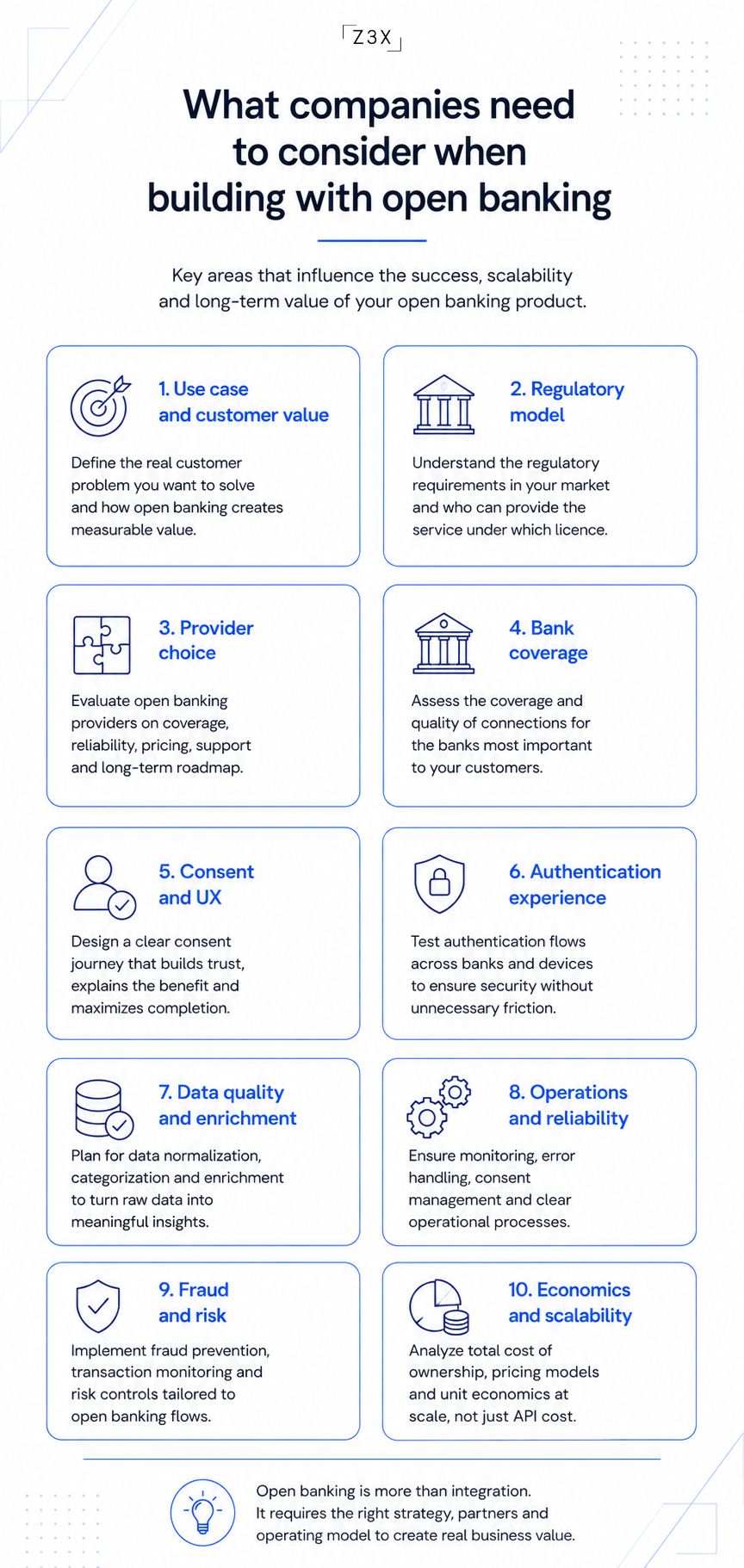
Open banking allows customers to give authorised third-party providers access to selected bank account data or payment functions.
This usually happens through secure APIs and only after the customer gives consent.
In practice, open banking can be used to connect bank accounts to FinTech apps, initiate payments, verify income, analyse cash flow or automate financial processes.
Open banking usually connects three parties: the customer, the third-party provider and the bank.
The customer starts the process inside a third-party application, selects their bank and approves the requested access.
The bank authenticates the customer and then communicates with the provider through an API.
Depending on the service, the provider may receive account information or send a request to initiate a payment.
An open banking API is a technical interface that allows banks and authorised third-party providers to exchange data or payment instructions in a structured way.
It can provide access to information such as balances, transactions and account details, or allow a provider to initiate a payment.
The exact functionality depends on the market, bank and regulatory framework.
An open banking API should be treated as infrastructure. The business value comes from the product or customer experience built on top of it.
So, is open banking safe?
In regulated markets, open banking is designed around customer consent, controlled permissions, secure authentication and defined access between banks and authorised providers.
Customers generally authenticate directly with their bank rather than giving their online banking password to the third-party provider.
However, safety also depends on the provider, technical implementation, data governance and customer behaviour.
Open banking reduces some risks associated with older methods of financial data sharing, but it does not eliminate fraud, cyber risk or poor implementation.
Open banking payments allow customers to initiate a payment directly from their bank account through a third-party application.
They are usually account-to-account payments.
Instead of manually creating a bank transfer, the customer selects their bank, authenticates and approves the payment within the payment journey.
For merchants, open banking can provide another checkout option alongside cards, wallets and local payment methods.
Open banking loans are lending products where open banking data is used as part of the application or credit assessment process.
A lender may use bank account data to verify income, analyse expenses, understand cash flow or support affordability assessment.
Open banking can reduce the need for manually uploaded bank statements and help automate parts of underwriting.
It does not replace credit risk management. The lender still needs appropriate risk models, lending policies, fraud controls and regulatory processes.
No.
Open banking mainly focuses on access to banking data and payment services, particularly those related to payment accounts.
Open finance extends the same principle to a broader range of financial products.
This can include investments, savings, pensions, insurance, mortgages and other forms of lending.
Open banking can therefore be seen as one part of the wider open finance model.
No, not in the same way.
Support depends on the country, regulatory framework, bank and type of account.
In some markets, banks are required to provide specific types of access. In others, connectivity depends more on commercial arrangements or industry standards.
Even where open banking is widely available, API quality, data scope and payment functionality can differ significantly between banks.
For companies building products across several markets, bank-level coverage should therefore be analysed rather than assumed.
In modern API-based open banking, customers generally should not need to provide their online banking credentials directly to the third-party provider.
Authentication normally takes place through the bank's own environment.
The provider receives the access or payment authorisation approved by the customer, not unrestricted access to the banking account.
This is one of the key differences between regulated API-based open banking and older methods of accessing financial data.
Yes.
The most common e-commerce use case is account-to-account payment initiation.
A merchant can add open banking as a payment method and allow customers to pay directly from their bank accounts.
Open banking can also support reconciliation, account verification and other financial processes.
Whether it makes commercial sense depends on the market, customer segment, transaction value and existing payment mix.
Yes.
SaaS companies can use open banking to add financial functionality to existing products.
Examples include automated transaction imports, cash-flow analysis, account verification, payments and embedded lending.
This can be particularly valuable for vertical SaaS platforms that already have operational data about a specific customer segment.
The strongest use cases usually combine banking data with the workflow the SaaS product already manages.
Not in every use case.
Open banking payments can compete with cards in some transactions, but the two models have different strengths.
Cards have mature global acceptance, established recurring payment models and well-developed refund and dispute processes.
Open banking can provide direct account-to-account payments, different transaction economics and strong integration with bank authentication.
For most merchants, the better question is not whether open banking should replace cards completely, but where it improves the existing payment mix.
So, what is open banking?
At its core, open banking is a model that allows customers to securely give authorised third parties access to selected banking data or payment functions. APIs, customer consent and authentication create the technical and regulatory foundation for that access.
But open banking is much more important as infrastructure than as a standalone concept.
It can support payments, lending, account aggregation, financial management, verification, accounting, reconciliation and embedded financial services. The same infrastructure can therefore create value in FinTech, e-commerce, SaaS and many other digital business models.
The market is also becoming more mature.
The first stage of open banking focused on creating access to bank accounts. The next stage is about improving reliability, expanding payment functionality, developing sustainable commercial models and moving towards broader open finance.
For businesses, this changes the strategic question.
It is no longer enough to ask whether open banking is available or whether an API integration is technically possible.
Companies need to understand which customer problem they want to solve, which data or payment capability is required, how the service will operate in a specific market and whether the economics support the product.
They also need to consider regulation, bank coverage, customer experience, security, data quality, operational processes and provider dependency.
This is where much of the real complexity sits.
A successful open banking product is therefore rarely just an API project. It is a product, regulatory, technology and go-to-market project at the same time. The strongest implementations are usually those where customers barely notice the infrastructure.
They simply experience a faster payment, easier onboarding, better financial insight, more automated workflow or quicker decision. That is where open banking creates real value: not by exposing banking infrastructure, but by making better financial products possible.
 Karol Zielinski
Karol Zielinski
Karol Zielinski
Karol Zielinski
Karol Zielinski